Everyone Talks About Speed. But Where Is the Time Actually Lost?
 2026-08-176 min read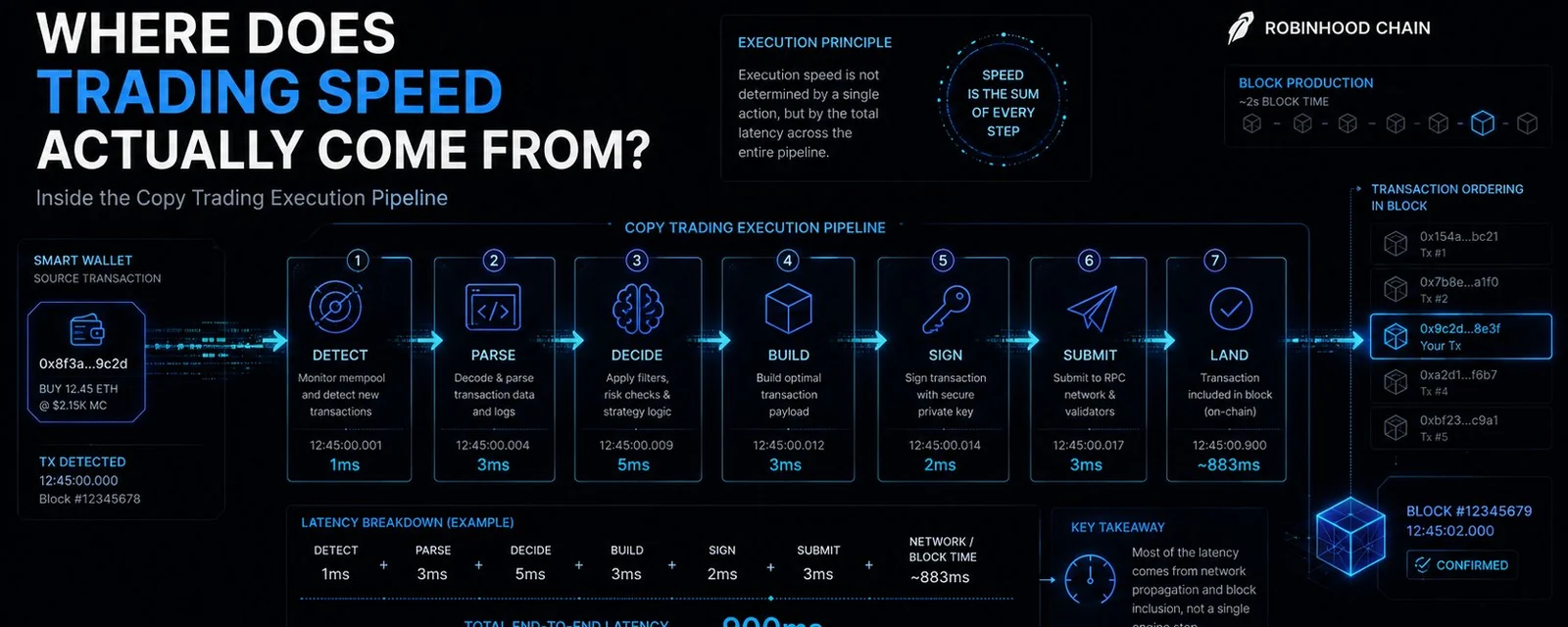
Everyone talks about execution speed on Robinhood Chain. But where is the time actually lost?
It's rarely one big delay. It's a chain of small ones. And in a market where blocks move fast, those small delays stack up quickly.
Here's what actually happens between a smart wallet buying and your copy trade landing on-chain.
1. More than two moments
Most traders only see two moments:
Target wallet buys → My wallet buys
But there's an entire execution pipeline between them:
Detect → Parse → Decide → Build → Sign → Submit → Land
Every step takes time, and every step can become a bottleneck.
2. Step 1: Detection
Before your bot can copy anything, it has to know the target wallet traded.
Sounds obvious. But how you detect that transaction matters. If one system sees the transaction earlier than another, the race is already uneven before execution even begins.
The first latency starts here.
3. Step 2: Parsing
Seeing a transaction isn't enough. The system has to understand it:
- What token was bought?
- Which route was used?
- Does it match the user's copy settings?
- Should the trade be executed?
The longer this logic takes, the more of your speed advantage disappears.
4. Step 3: Decision
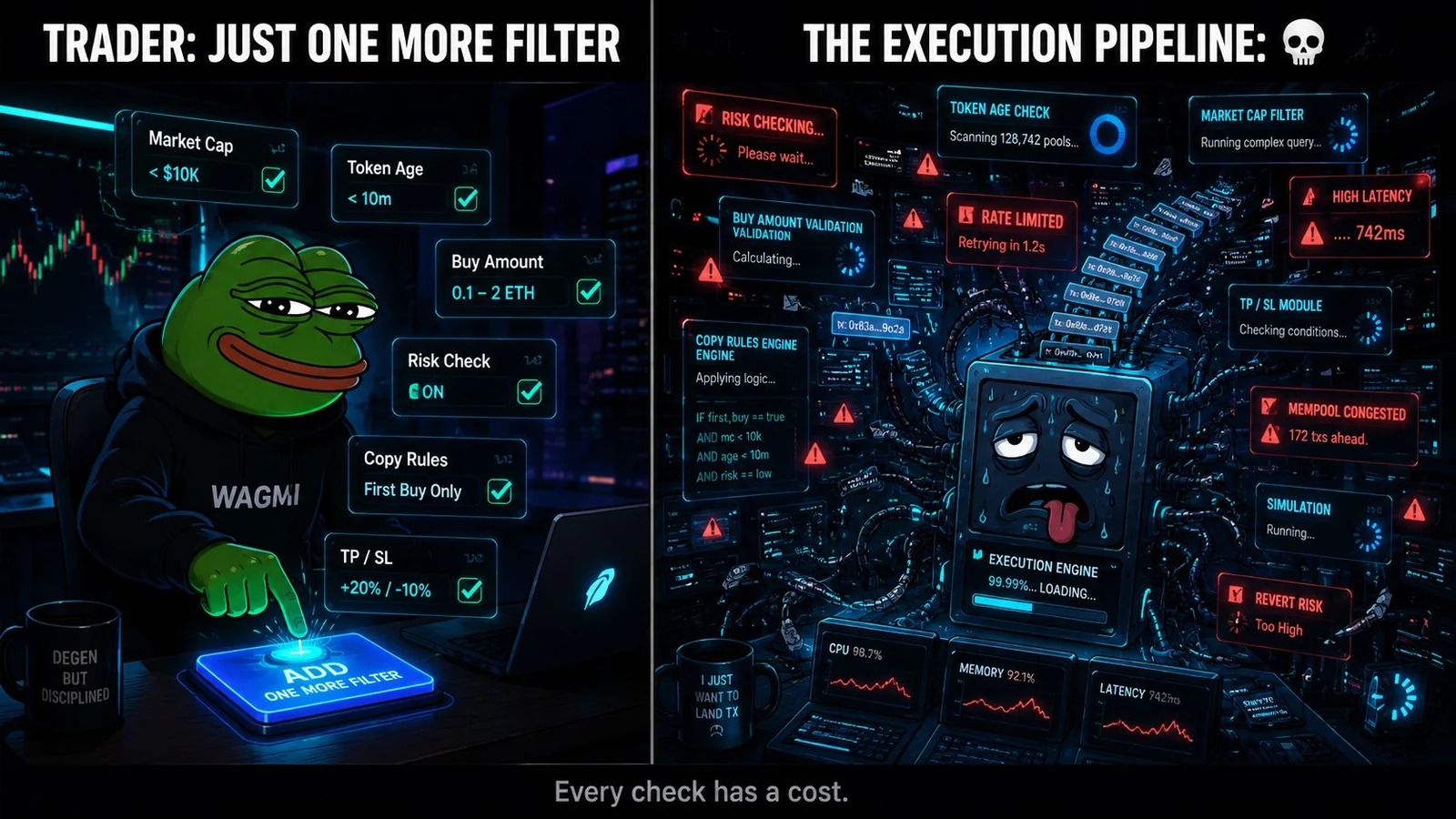
This is where trading settings start to matter. The system may need to check:
- Market cap
- Buy amount
- Token conditions
- Copy rules
- Risk settings
More logic can mean better filtering. But every extra check also has an execution cost. This is one of the trade-offs every fast trading system has to solve.
5. Step 4: Transaction preparation
Once the decision is made, the trade still needs to be built: route, amount, slippage, contract interaction, signature.
If everything is prepared only after the signal arrives, you're already spending valuable time. Good execution infrastructure tries to move as much work as possible before the race starts.
6. Step 5: Submission
Now the transaction is ready, but it still has to reach the chain. And on Robinhood Chain, this part matters a lot.
You can't simply assume higher fee = faster execution. The important question becomes: how quickly can your transaction reach the ordering layer?
That turns network architecture into trading infrastructure.
7. Step 6: Block inclusion
Finally, your transaction lands. This is the only part most traders ever see. They open the explorer and compare:
- Target wallet: Block N
- Copy wallet: Block N+1 / N+2 / N+3...
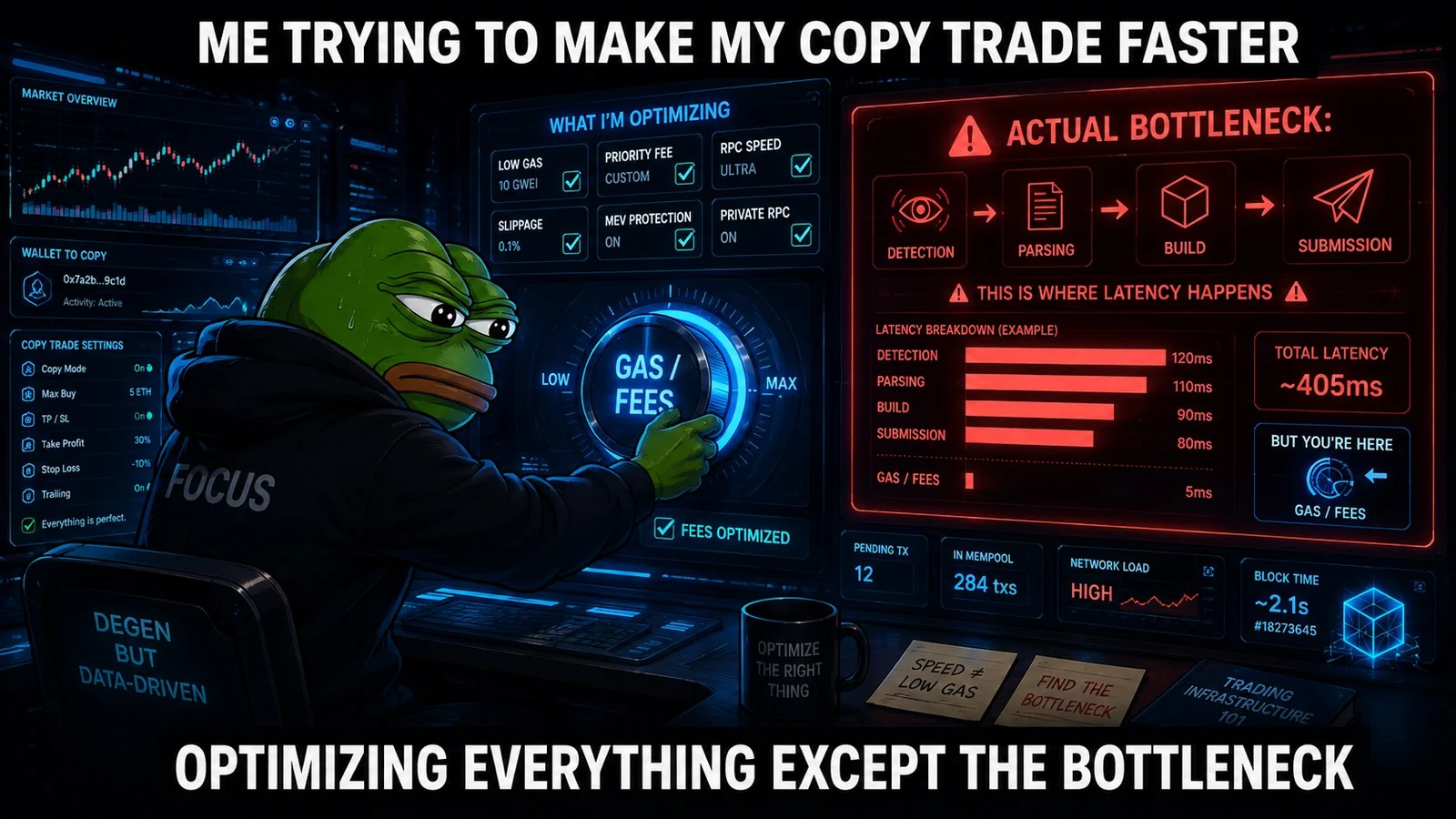
But the block difference is only the final result. The real race happened earlier:
Detection → Parsing → Decision → Preparation → Submission
8. Same signal, different infrastructure
This is why two copy trading bots following the exact same wallet can still produce different entries.
Same signal. Same chain. Same target. Different infrastructure.
Speed isn't one feature. It's the result of the entire execution pipeline.
9. Ask the right question when choosing a bot
This changes how we think about copy trading. The question shouldn't only be:
"How fast is this bot?"
Ask instead:
"Where does this bot remove latency?"
Detection? Parsing? Pre-execution? Submission? The answer tells you much more than a marketing number ever will.
The bottom line
That's also the direction we're building TradeWiz around:
- Reduce unnecessary steps
- Prepare earlier
- React faster
- Get the transaction on-chain with as little wasted time as possible
Because in fast markets, the edge is often hidden in the milliseconds users never see.
Trade Fast. Trade Smart.