What Is Copy Trading? How It Works and What to Know
 2025-07-209 min read
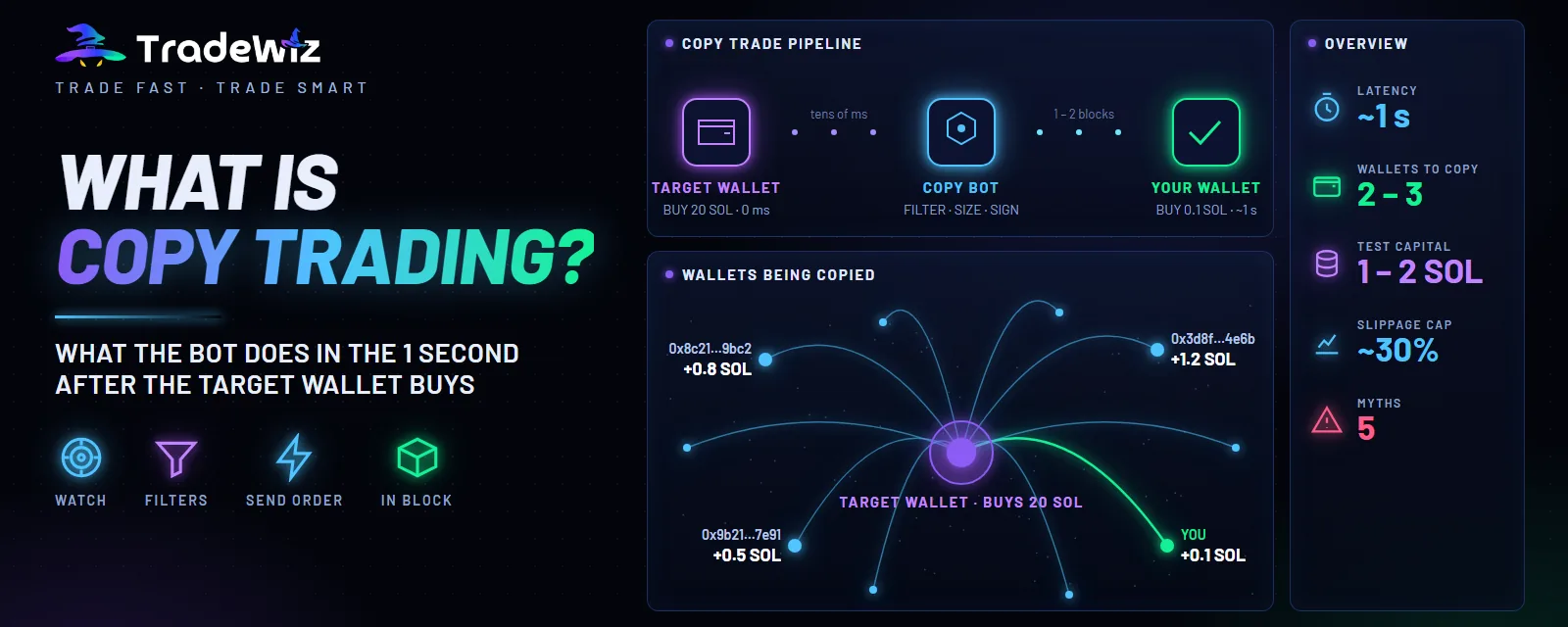
You spot a Solana wallet that bought a token at a market cap of a few tens of thousands of dollars and sold after a 10x. The obvious question: what if you did exactly what that wallet did, at the same moment? Copy trading is the answer to that question, and it's also where a lot of beginners lose money because they misunderstand it.
This post explains copy trading from the ground up: what it is, what the bot does in the second or so after the target wallet hits buy, how it differs from copy trading on an exchange, and what you need to know before you put in your first SOL.
Quick summary
- Copy trading means letting a bot buy and sell automatically after another wallet, with the trade size and risk limits you set.
- Copying on-chain wallets is more transparent than copying on an exchange, because every trade can be verified. The trade-off: you pick the wallets yourself and you eat the price gap.
- A profitable wallet doesn't mean a profitable copy. You're always one step behind and you pay extra fees.
- Success comes down to three things: picking the right wallets, setting risk limits, and having your own exit plan.
What is copy trading?
Copy trading means replicating someone else's trades. They buy, you buy. They sell, you sell. An automated system does the copying for you, so you don't have to sit and watch the screen.
There are two very different kinds of copy trading:
- Copy trading on a centralized exchange. You pick a "lead trader" from a list the exchange gives you, and the exchange places the orders in your exchange account. Popular for futures trading.
- On-chain wallet copy trading. You pick any wallet address on the blockchain. A bot watches that wallet and places the same kind of trade from your own wallet. This is by far the most common approach in the Solana memecoin market.
The rest of this post focuses on on-chain wallet copying, since that's what you're doing when you use a bot like TradeWiz.
How a copy trading bot works
Everything happens in about one second. On Solana a new block is produced roughly every 400 milliseconds, so being a few hundred milliseconds late can mean a meaningfully worse price.
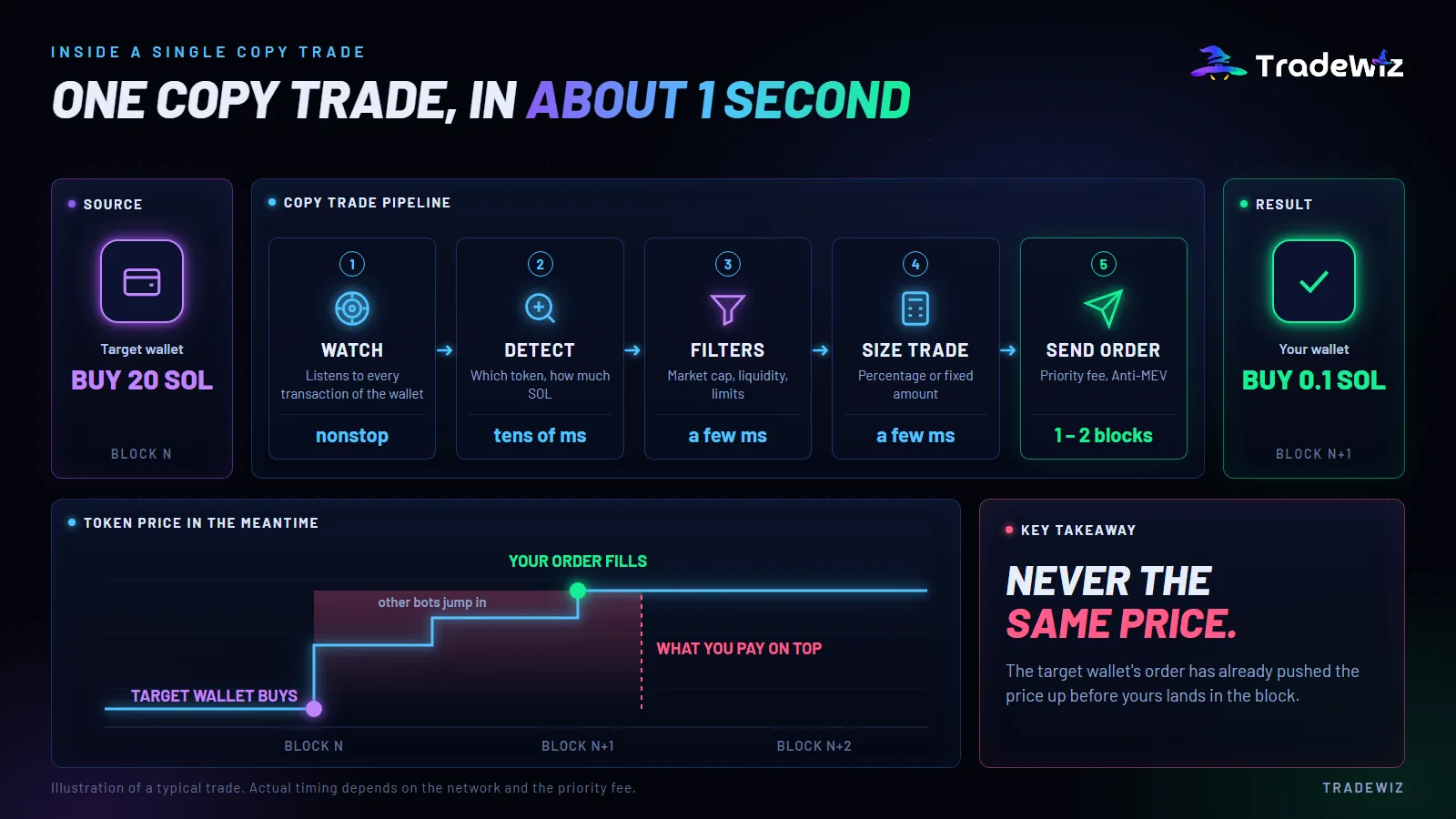
- Watch. The bot listens for every transaction from the target wallet as soon as it hits the network.
- Detect. When it sees that wallet swap SOL for a token, the bot works out which token, how much, and on which pool.
- Check filters. The bot compares it against your settings: market cap, liquidity, token age, how many times you've already bought this token, and your remaining SOL limit. If it fails a filter, it's skipped.
- Size the trade. You buy either as a percentage of their trade or a fixed amount, clamped between the minimum and maximum you set. The target wallet can go in with 20 SOL and you can still copy with 0.1 SOL.
- Send the order. The bot sends the transaction with a priority fee so it lands early in the block. With Anti-MEV on, the order goes through a private channel so sandwich bots can't see it coming.
- Copy the sell. When the target wallet sells, the bot sells too, either everything or the same proportion they sold. You can also set your own take profit and stop loss so you don't depend on them.
The key thing to understand: you never get the same price as the target wallet. Their buy has already pushed the price up before yours lands. That gap is small on tokens with deep liquidity and huge on tokens that just launched.
Exchange copy trading or on-chain wallet copying?
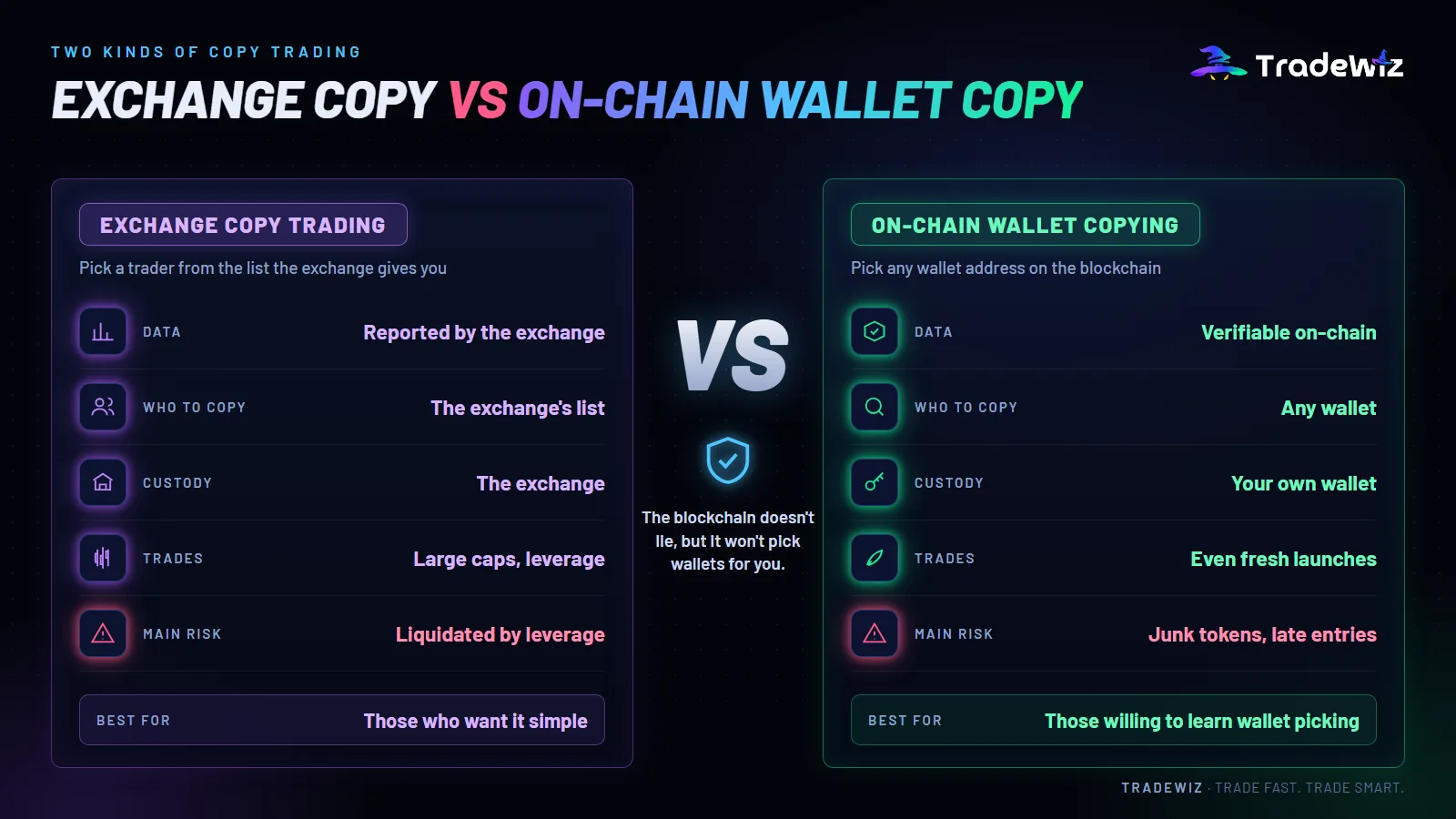
| Criteria | Exchange copy trading | On-chain wallet copying |
|---|---|---|
| Trade history | Shown by the exchange, you can't verify it yourself | Every trade is on the blockchain, anyone can check it |
| Who you can copy | Whoever is on the exchange's list | Any wallet you can find |
| What gets traded | Mostly large caps, often with leverage | On-chain tokens, including fresh launches |
| Who holds the funds | The exchange | Your wallet, you hold the private key |
| Costs | Profit share for the lead trader, plus exchange fees | Bot fee, network fee, pool fee |
| Biggest risk | Leverage, cherry-picked track records | Junk tokens, late entries, price gap |
| Skill required | Low | Higher, mostly in picking wallets |
Exchange copy trading is easy to start, but you're putting full trust in the numbers the exchange shows you. A trader can run several accounts and only show the one that's winning. A big leveraged position can wipe out an account in a single candle.
On-chain wallet copying is the opposite. Nobody can rewrite blockchain history, so you can look at every buy, sell, win and loss of a wallet before you decide. The price you pay is doing the vetting yourself and carrying the risk of the new-token market, where most tokens lose nearly all their value within the first few hours.
In short: the blockchain doesn't lie, but it won't pick wallets for you either.
Real pros and cons
Pros
- No chart-watching. The bot works 24/7, even while you sleep.
- Learn from better traders. Watching where a good wallet enters, how long it holds and how it takes profit beats any course.
- Transparency. You can verify a wallet's track record before you put money in.
- Clear risk control. The SOL limit per wallet is the most you can lose on that wallet.
Cons
- Always one step behind. You buy higher and sell lower than the target wallet.
- Fixed fees hurt small trades. A 0.05 SOL trade needs the token to rise almost 19% just to break even. See how fees work on the TradeWiz fee page.
- Good wallets change style. A wallet that won last month isn't guaranteed to win this month.
- Some wallets deliberately bait copiers. They buy a small test position so copy bots pile in and push the price, then sell into that very buying pressure.
5 myths that cost beginners money
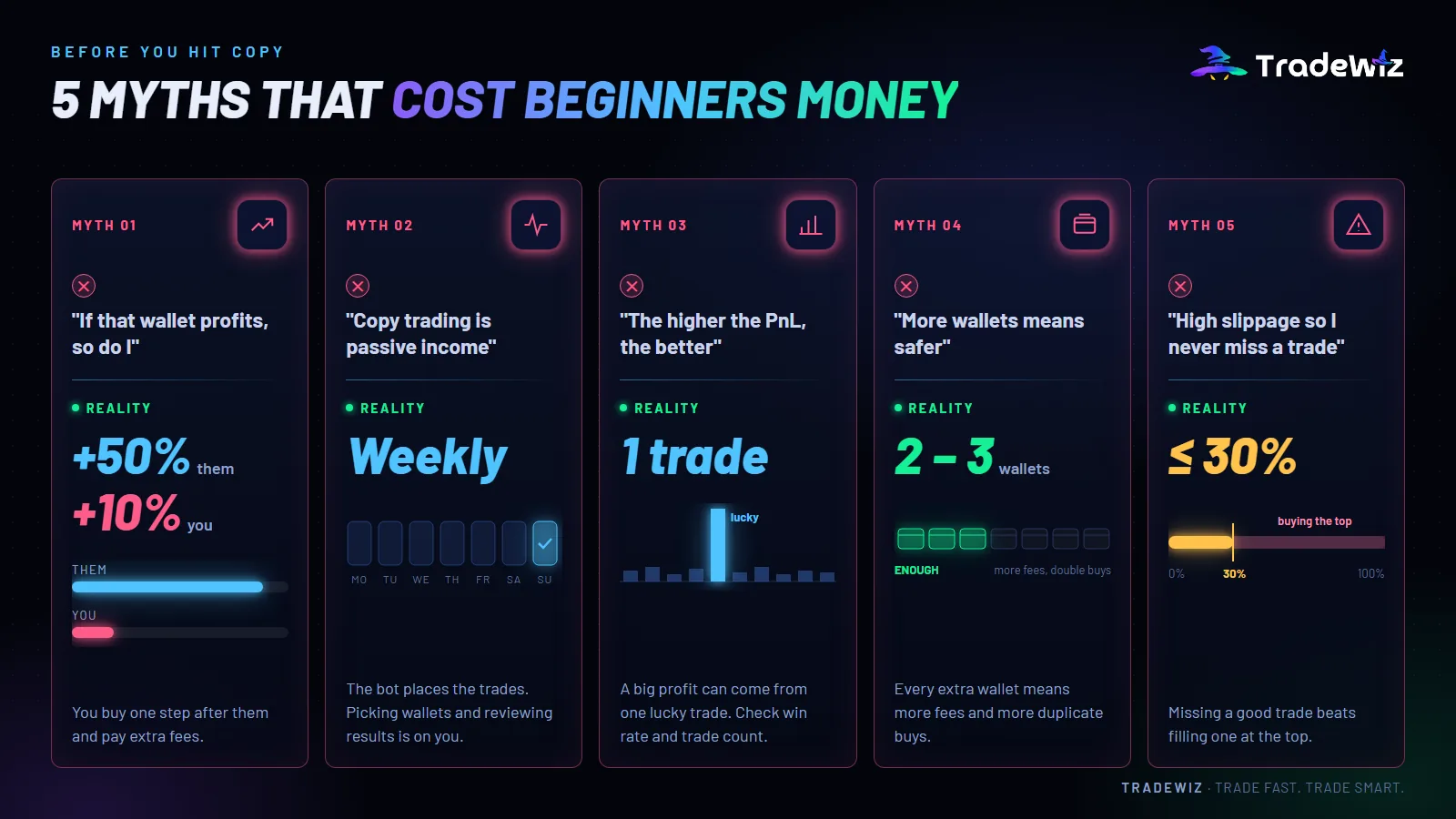
1. "If that wallet profits, so do I"
The target wallet buys at the price before it gets pushed, you buy at the price after. They can be up 50% while you're only up 10%, or down if the token only moves a little. The post on where copy-trade speed is lost breaks down where that gap comes from.
2. "Copy trading is passive income"
The bot places the trades, but picking wallets, tracking results and replacing bad wallets is on you. At least once a week, review each wallet: net profit after fees, number of failed trades, and whether it still trades the way it did when you picked it.
3. "The higher the PnL, the better the wallet"
A wallet with a big profit might owe it all to one lucky trade, or most of the gains might still be unrealized. Look at win rate, number of trades, holding time and size per trade. The Smart Money guide shows how to dig into the wallets behind a token.
4. "The more wallets I copy, the safer I am"
Every extra wallet means another set of fees per trade and a higher chance of buying the same token twice. With 1–5 SOL of capital, two or three carefully picked wallets beat ten picked in a hurry.
5. "High slippage so I never miss a trade"
Wide slippage means you accept buying at any price in that range, including the top. Missing a good trade is better than filling a bad one. For new tokens, around 30% slippage is a sensible ceiling.
Who should and shouldn't copy trade
It's a fit if:
- You don't have time to watch charts but want exposure to the on-chain token market.
- You have capital you can afford to lose entirely without it affecting your life.
- You're willing to spend time picking wallets and reviewing results every week.
Hold off if:
- It's money you'll need in the next few months.
- You expect steady monthly returns like a savings account.
- You have less than 1 SOL. Fixed fees will eat almost all of your profit.
What you need to get started
| What you need | Suggestion |
|---|---|
| Capital | 1–2 SOL for the testing phase, only money you can afford to lose |
| Wallet | A separate wallet just for trading, never your storage wallet |
| Target wallet list | 2–3 wallets with at least 30 days of checked history |
| Limits | A total SOL limit per wallet, one buy per token |
| Exit plan | Your own take profit and stop loss, not just waiting for the target to sell |
| Time | The first 20–30 trades to evaluate before adding more funds |
For the exact settings to start with, see standard copy-trade settings.
FAQ
Is copy trading guaranteed to be profitable?
No. Copy trading copies someone else's decisions, including the bad ones. Results depend on the wallets you pick, your trade size and how you exit. Treat the early phase as a learning phase.
Can I copy any wallet?
Yes. On the blockchain every wallet is public. All you need is the address. The target wallet doesn't know about, and doesn't need to agree to, you copying it.
How is copy trading different from sniping?
Copy trading follows a person. Sniping follows an event, for example buying the instant a new token is created with a ticker or creator you choose. Sniping is faster but far riskier. More in the Sniper guide.
Does the bot hold my money?
Your funds sit in a Solana wallet the bot creates for you, and you can export the private key to hold it yourself. Since the bot has to sign transactions for you, treat it as a trading wallet and only keep the capital you're actively using in it. Never share your private key or seed phrase with anyone, and move profits out to a separate storage wallet regularly.
Where do I find wallets to copy?
Three common sources: the bot's Smart Money feature to see the most profitable wallets on a token, the featured wallets on the TradeWiz homepage, and digging into the early buyers of tokens that have already run hard.
Key takeaway
Copy trading isn't the problem. Copying the wrong person, in the wrong place, with the wrong expectations is. The bot handles the fast part. The smart part is yours: pick wallets based on data rather than the crowd, set limits before you hit copy, and always have your own exit plan.
When you're ready, start with TradeWiz on Telegram and 1–2 SOL. Every setting is explained in detail in the Copy Trading guide.
Trade Fast. Trade Smart.