Copy Trading vs Manual Trading Memecoins: Which Fits You?
 2026-10-209 min read
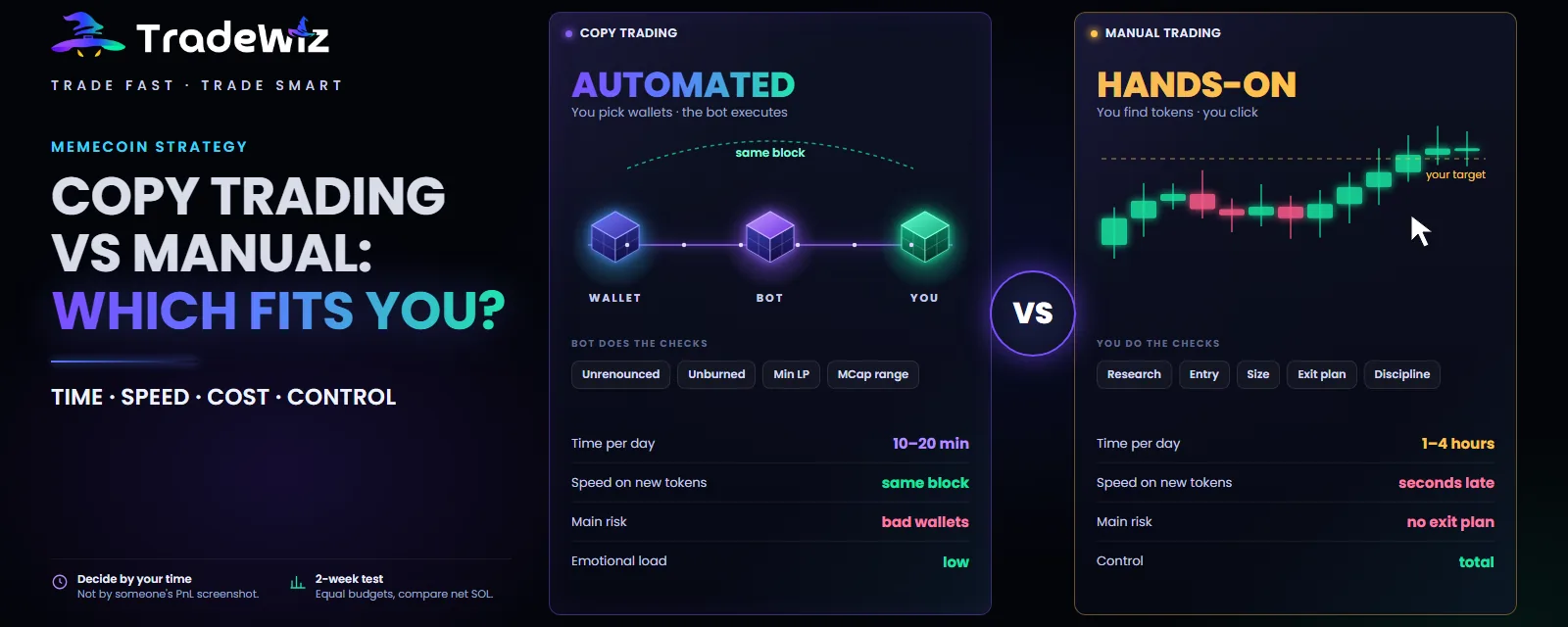
Ask ten memecoin traders whether copy trading or manual trading is better and you will get ten confident answers. Most of them are about the trader, not the method. Copy trading vs manual trading is not a question of which one makes more money in general. It is a question of which one fits your time, your skills and your temperament, because the method you can actually stick to beats the "better" one you abandon in two weeks.
This post compares both side by side, shows who each one suits, and ends with the hybrid setup many experienced traders use, plus a two-week test to settle it with your own numbers.
Quick summary
- Copy trading moves your work from picking tokens to picking wallets and setting risk limits. It saves time but adds its own risks: late copies, bad wallets, fees.
- Manual trading gives you full control and no copy delay, but it costs hours of attention and is where most emotional mistakes happen.
- Most people with a job are better off starting with copy trading; people with time and a real edge do better manually or with a hybrid.
- Don't guess: run both with small, equal budgets for two weeks and compare net SOL after fees.
What each one actually is
Copy trading means a bot mirrors the trades of wallets you choose, within the limits you set. You no longer decide which token to buy. Your job becomes choosing the wallets, sizing each copy and deciding how you exit. If you are new to the idea, start with What Is Copy Trading? How It Works and What to Know.
Manual trading means you find the token, decide the entry, the size and the exit yourself. Your edge is your research, your timing and your discipline.
Both are trading. Neither is passive. They just put the hard part in different places.
Side by side
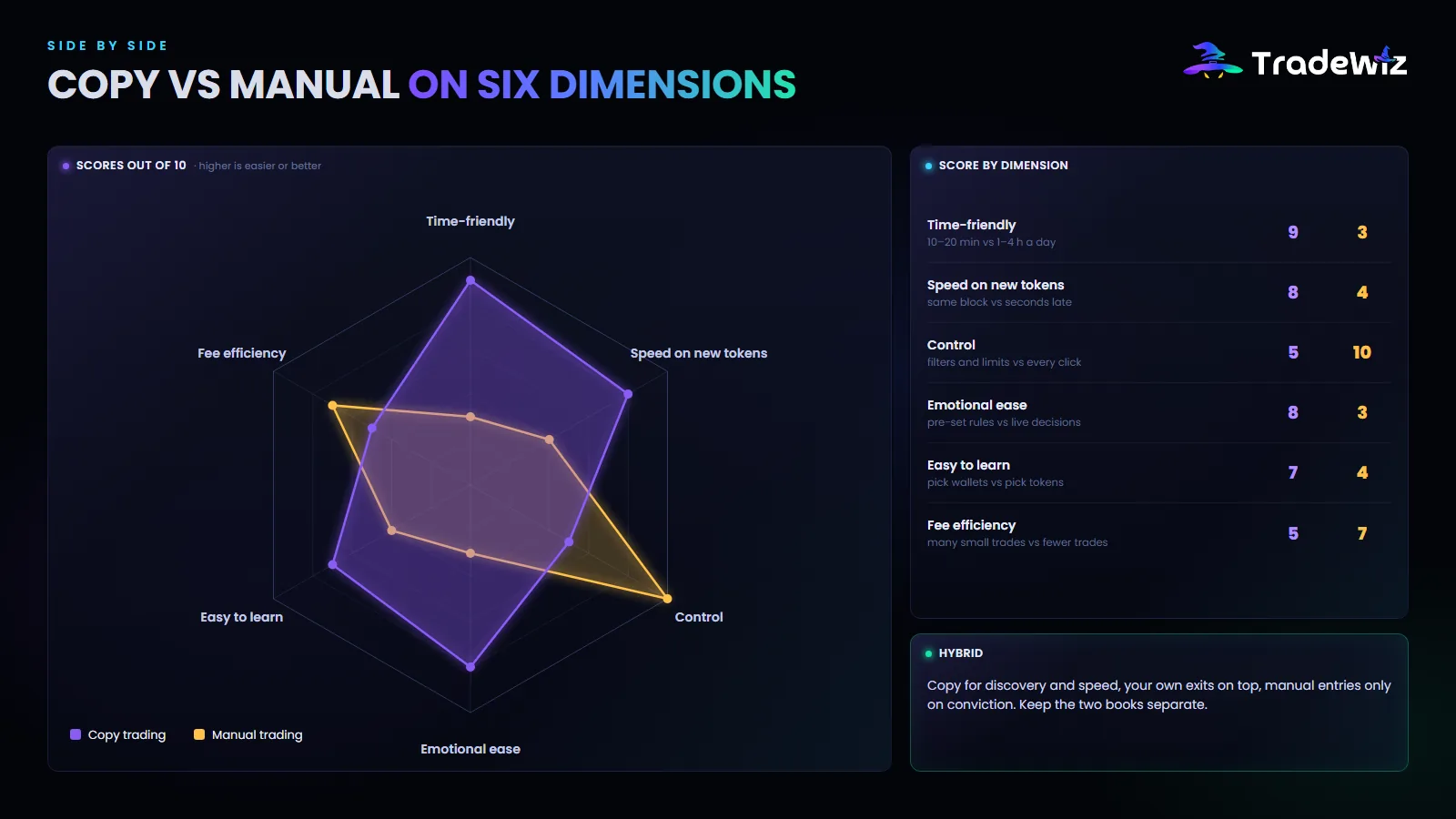
| Copy trading | Manual trading | |
|---|---|---|
| Time per day | 10–20 minutes to review | 1–4 hours of active watching |
| Main skill | Choosing wallets, setting limits | Finding tokens, timing, discipline |
| Speed on new tokens | Can land in the same block as the wallet with a fast bot | Usually seconds to minutes behind the first buyers |
| Control | Indirect: filters, size, exits | Total |
| Typical cost problem | Many small trades, so fixed fees add up | Chasing pumps, so slippage adds up |
| Emotional load | Lower, decisions are pre-set | High: FOMO, revenge trades, fatigue |
| Typical failure | Bad or bait wallets, copying late | No exit plan, overtrading |
| Scales with capital | Yes, across several wallets | Limited by your attention |
Two rows deserve a closer look.
Speed. On a fresh memecoin, the first minutes decide the entry price. A fast copy bot can buy in the same block as the wallet it follows; a person reading a chart rarely can. But copying only helps if the wallet itself entered well. Why a good wallet can still leave you with a bad price is covered in Why You Lose Copying a Winning Wallet.
Cost. Copying a wallet that trades 100 times a day for small moves can burn your profit in fees. Each round trip carries about 0.008 SOL in fixed fees on top of the percentage fees, as shown in Solana Copy Trading Fees: 1% Is Just the Tip of the Iceberg. Manual traders pay less in fees but often more in slippage, because they buy tokens that are already running.
Who copy trading suits
- You have a job or other commitments and can't watch charts for hours.
- You are new and want to learn risk management before token picking.
- You are comfortable with rules: limits, filters, automatic exits.
- You have at least 1–2 SOL, enough to spread across 2–3 wallets at sensible trade sizes.
The work you can't skip is choosing wallets. Use the scorecard in How to Find Smart Money Wallets Worth Copying on Solana and test each wallet small for a week.
Who manual trading suits
- You have time to be in the market when it moves, and you enjoy it.
- You have an edge you can describe in one sentence: you follow a community early, you read narratives well, you are disciplined about exits.
- You can take a loss, close the app and not try to win it back in the next trade.
If you can't name your edge, the market will name it for you, usually as "the person the early wallets sold to".
The hybrid many experienced traders use
You don't have to choose one. A common setup combines both and lets each do what it is good at:
- Copy for discovery and speed. Copy 2–3 tested wallets with small sizes and filters on. Their buys act as a stream of pre-screened ideas, executed instantly.
- Your own exits on top. Turn on Copy Trade Auto Sell with your own stop loss, and use First Sell Copy Percentage to exit part of a position as soon as the wallet starts selling, instead of waiting for it to dump everything.
- Manual for conviction. When a copied token fits your own thesis, add a manual position with a planned exit, for example a limit sell at a target market cap. See the Limit Orders guide.
- Separate the books. Label copy tasks clearly and log manual trades separately, so you know which side is actually making money.
Every setting above is described in the Copy Trading guide.
Settle it with a two-week test
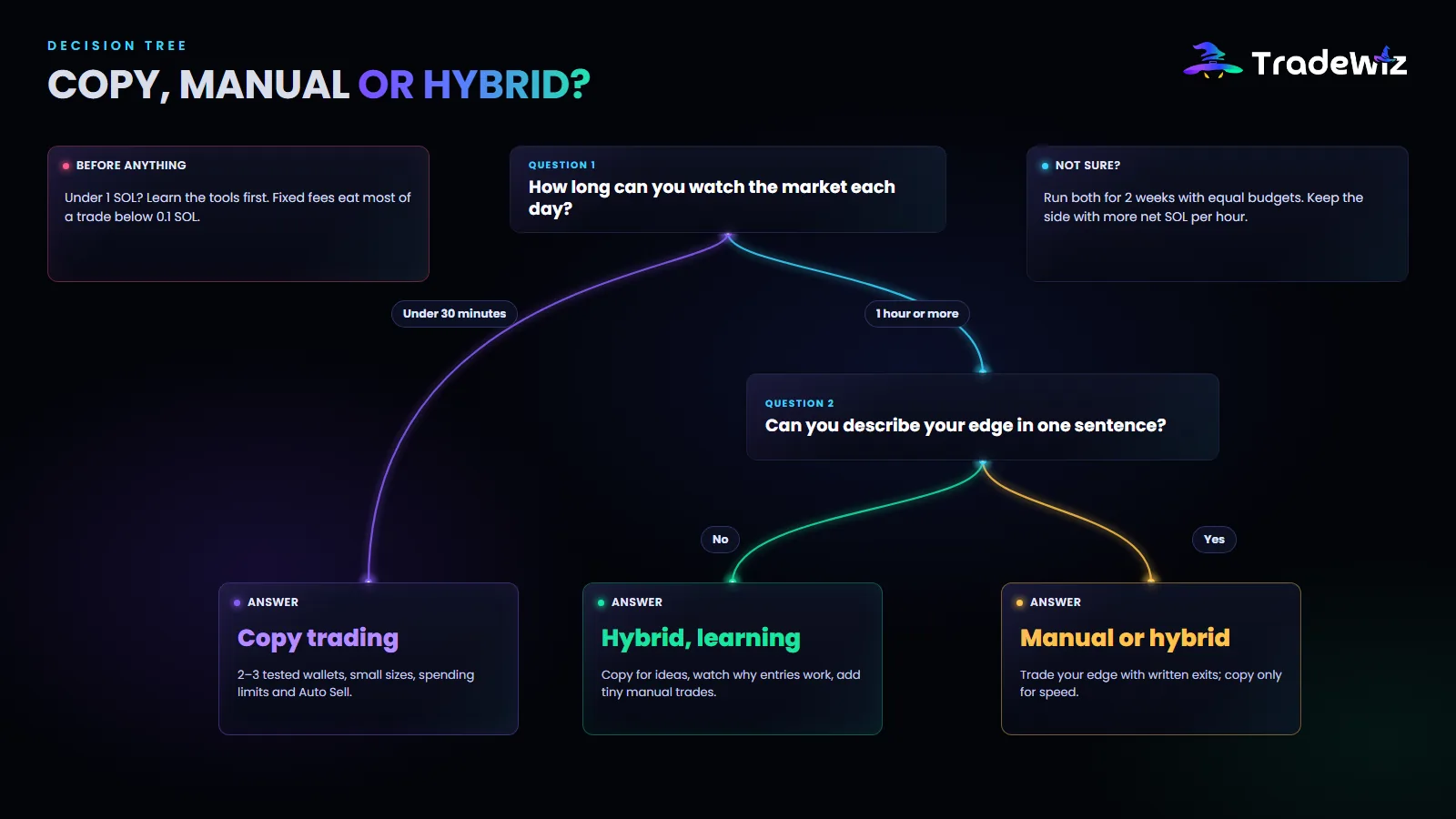
Opinions are cheap; two weeks of data aren't. Run both side by side with equal, small budgets:
- Copy side: one or two wallets, 0.05–0.1 SOL per trade, a SOL Spending Limit of 0.5 SOL in total.
- Manual side: 0.5 SOL in total, at most 0.1 SOL per trade, every trade with a pre-set exit.
- Track three numbers for each side: net result in SOL after all fees, hours spent, and how many trades broke your own rules.
- After 14 days, keep the side that made more per hour of your time with fewer broken rules. If both lost, shrink sizes and fix the biggest leak before adding money.
FAQ
Is copy trading passive income?
No. The bot executes, but you still choose wallets, review results weekly and drop wallets that change style. It is less time, not no time.
Which is more profitable, copy trading or manual trading?
Neither by default. Results depend on the wallets you copy or the edge you trade. What differs is time and stress per unit of profit, which is why the two-week test is worth doing.
Can I copy trade and trade manually from the same wallet?
Yes, but keep the records separate and give each copy task its own spending limit, otherwise you won't know which side is working.
Do professional traders use copy trading?
Many use it as a tool rather than a strategy: to follow wallets they have researched, to react instantly, or to get alerts while they decide manually.
What's the biggest mistake on each side?
Copy traders copy wallets they haven't tested. Manual traders trade without a written exit.
Key takeaway
Copy trading vs manual trading comes down to where you want the hard work to sit. Copy trading trades screen time for wallet selection and settings; manual trading trades convenience for control. Start where your time and temperament point, combine them once you know your numbers, and let a two-week test decide instead of the loudest voice on X.
Both sides, plus the hybrid tools, are in TradeWiz.
Trade Fast. Trade Smart.