Memecoin Trading for Beginners: Your First 30 Days (2026)
 2026-10-2011 min read
Most people who start memecoin trading lose their first deposit within a week. Usually not because they picked the wrong token, but because they had no plan: they bought whatever was trending, sized every trade the same, never set an exit, and found out about fees after the money was gone.
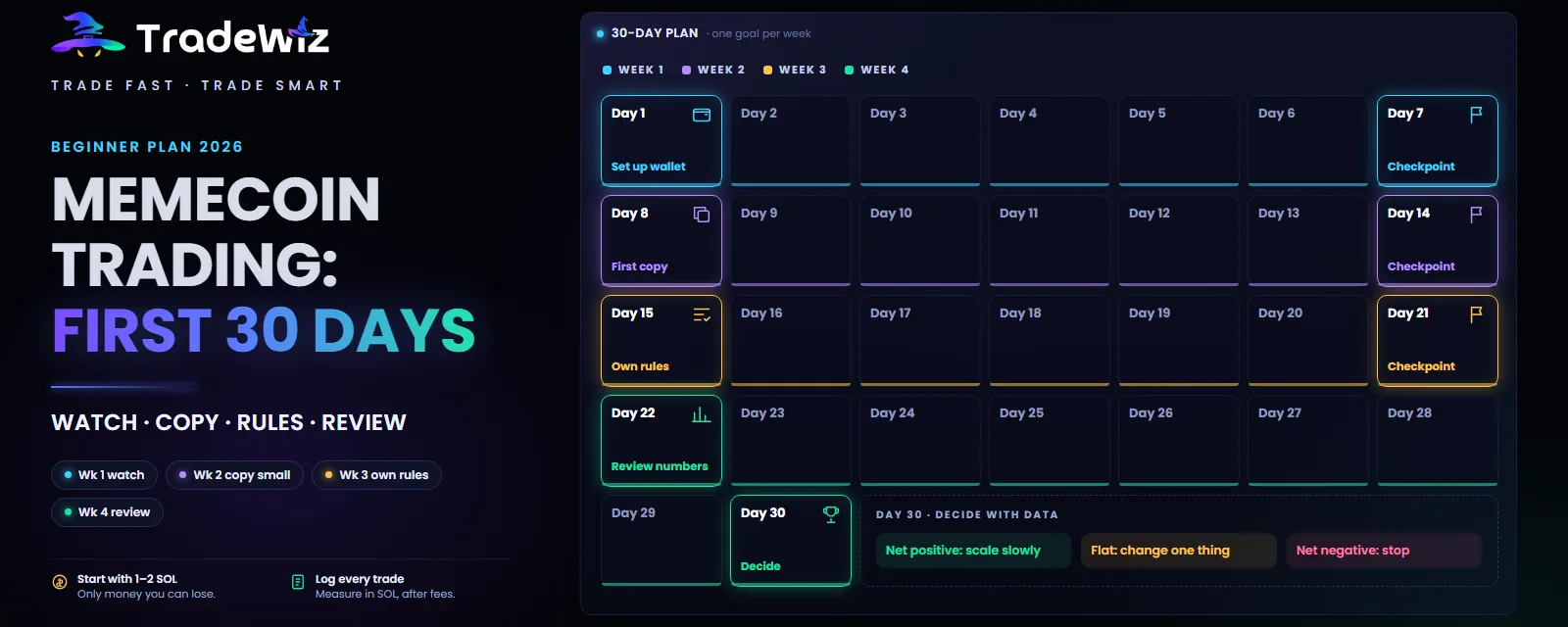
This is a 30-day plan for memecoin trading for beginners on Solana. It is built to do one thing: get you through the first month with most of your capital and a clear answer to the only question that matters, does this work for me?
Quick summary
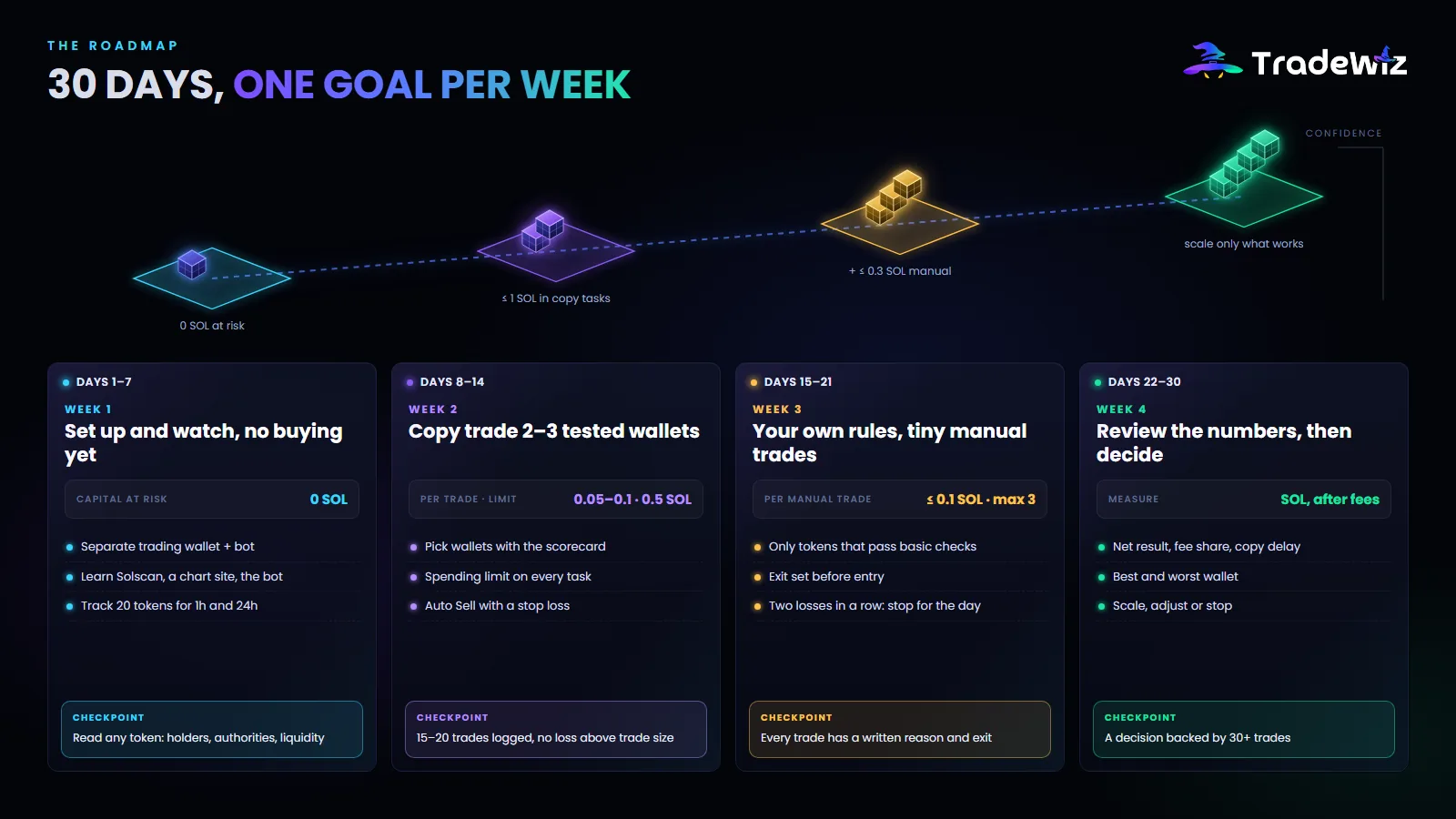
- Week 1: set up a separate trading wallet and a bot, then watch the market without buying.
- Week 2: copy trade 2–3 tested wallets with 0.05–0.1 SOL per trade and a hard spending limit.
- Week 3: add your own small manual trades, only on tokens that pass basic checks, always with an exit plan.
- Week 4: review your numbers after fees and decide: scale, adjust or stop.
Before day 1: what you need
- A Solana wallet you only use for trading. Phantom or the wallet a bot creates for you. Never your savings wallet.
- A trading bot. Memecoins move in seconds; a Telegram bot like TradeWiz gives you fast buys, copy trading and automatic exits.
- 1–2 SOL you can afford to lose completely. Less than that and fixed network fees eat most of your results; we show the math in Solana Copy Trading Fees: 1% Is Just the Tip of the Iceberg.
- A simple journal. A spreadsheet with date, token, size, entry, exit, result in SOL and one line on why.
And one honest expectation: memecoins are the highest-risk corner of crypto. Only about 1 in 50 Pump.fun tokens even completes its bonding curve. Your goal in month one is not to get rich. It is to learn without losing your stake.
Week 1 (days 1–7): set up and watch
Goal: understand how memecoins move before you put money in.
- Set up safely. Create the trading wallet, write the private key on paper, fund it with your 1–2 SOL. The rules in Are Trading Bots Safe? 10 Rules to Keep Your Wallet Safe take ten minutes to read and save most beginners from the most expensive mistake there is.
- Learn three tools. A token page on Solscan (holders, authorities, transactions), a chart site like DexScreener, and your bot's buy and sell screens.
- Watch 20 tokens without buying. Pick new tokens that are trending. Write down the price when you found it, then check it 1 hour and 24 hours later. You will see the pattern quickly: most fade, a few run, and the runs are short.
Checkpoint: you can open any token and say who holds the supply, whether the dev can mint more, and how deep the liquidity is.
Week 2 (days 8–14): copy trade small
Goal: make your first trades with someone else's decisions and your own limits.
Copy trading is the best first step for a beginner because it separates two skills: picking tokens and managing risk. A good wallet does the picking; you only manage size and exits.
- Pick 2–3 wallets with the scorecard in How to Find Smart Money Wallets Worth Copying on Solana: holding time over 3 minutes, a few trades a day, mostly realized profit, 30+ days of history.
- Set small, hard limits for each copy task: 0.05–0.1 SOL per trade and a SOL Spending Limit of about 0.5 SOL. That limit is the most you can lose on that wallet.
- Turn on Auto Sell with a stop loss so no trade can ride to zero. The step-by-step setup is in Solana Copy Trading for Beginners.
- Log every trade. Was your copy in the same block? How much higher was your entry than the wallet's?
Checkpoint: 15–20 copied trades logged, no single loss bigger than your per-trade size.
Week 3 (days 15–21): your own rules, your first manual trades
Goal: start making your own calls on a tiny budget, with rules written down before you trade.
- Max 0.1 SOL per manual trade, and no more than 3 open at once.
- Only buy tokens that pass basic checks: mint and freeze authority revoked, liquidity burned or locked, no wallet holding a big share, no obvious bundle in the first block.
- Set the exit before you buy: for example sell 50% at +100%, stop loss at -30%. Memecoin Take Profit: Auto Sell, Trailing Stop or Limit Order? explains the tools.
- No revenge trades. Two losses in a row means you stop for the day.
Curious about sniping new launches? Wait until week 4 at the earliest, and then only with a fixed budget of 0.5 SOL and tight filters, as described in How to Snipe New Pump.fun Tokens the Right Way.
Checkpoint: every manual trade had a written reason and a pre-set exit.
Week 4 (days 22–30): review the numbers
Goal: decide with data, not with your last trade.
Calculate these from your journal and your SOL balance, not from the PnL card in the bot, which leaves out network fees:
| Number | How to get it | What it tells you |
|---|---|---|
| Net result in SOL | Balance now minus deposits | The only result that counts |
| Fees share | Fees paid ÷ total traded | Whether your size is too small |
| Win rate and average win vs loss | From the journal | Whether a few big wins carry you |
| Copy delay | Blocks behind the target wallet | Whether settings or wallets need work |
| Best and worst wallet | Net result per copy task | Which wallet to keep, which to drop |
Then decide:
- Net positive after fees over 30+ trades: scale slowly, for example add 50% more capital to what already works.
- Roughly flat: change one thing (a wallet, trade size or exit rule) and run two more weeks.
- Clearly negative: stop, review the journal and don't add money. That is a successful month too: it cost you less than learning the same lesson with ten times the stake.
How to split a starter budget
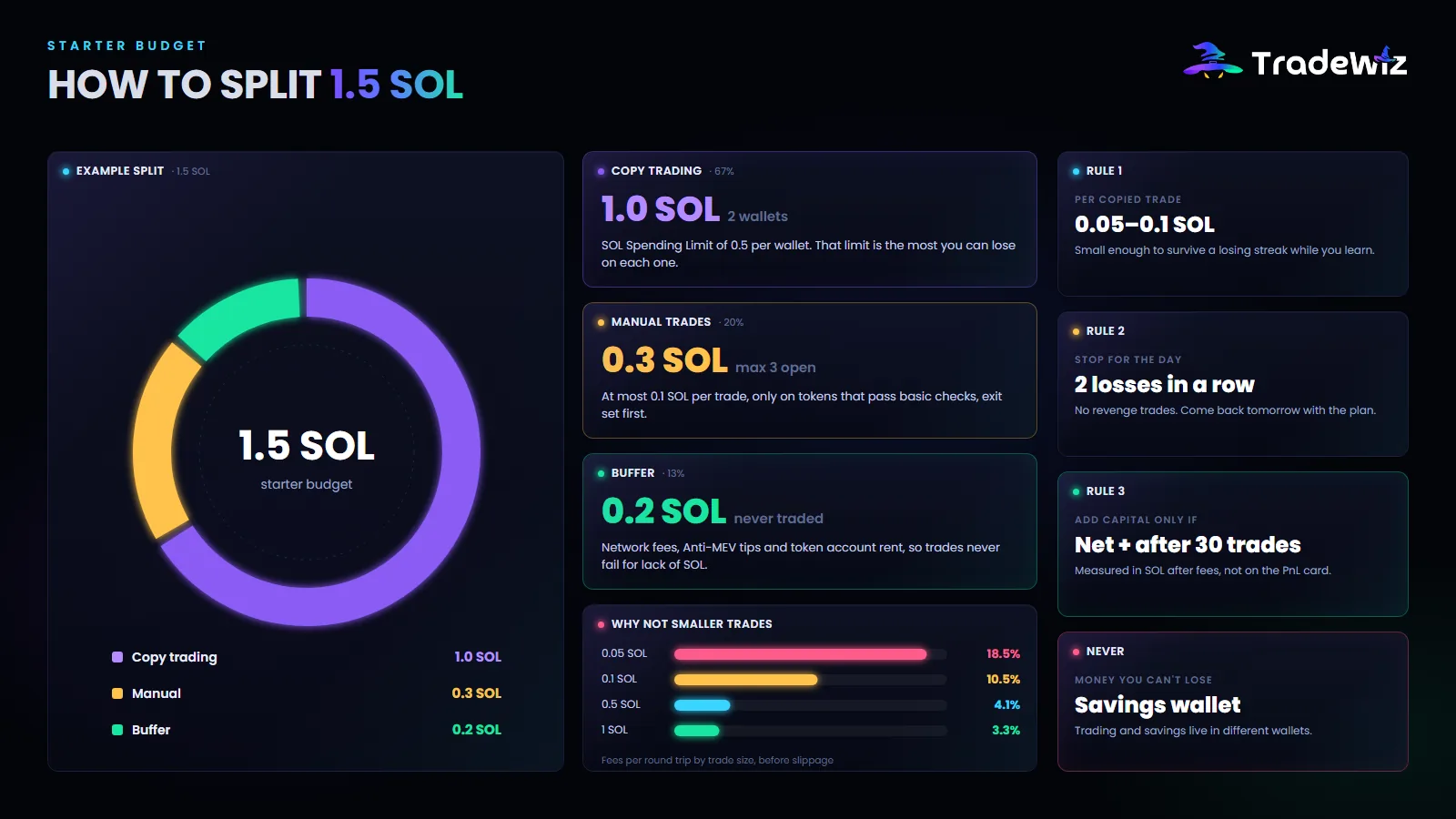
An example with 1.5 SOL:
- 1.0 SOL for copy trading: two wallets with a 0.5 SOL Spending Limit each.
- 0.3 SOL for manual trades: three trades of 0.1 SOL at most.
- 0.2 SOL buffer: network fees, Anti-MEV tips and token account rent. Every round trip costs about 0.008 SOL in fixed fees, so a buffer keeps trades from failing.
8 rules that keep beginners alive
- Trade only money you can lose entirely.
- Keep trading and savings in separate wallets.
- Every trade has an exit before it has an entry.
- Size so that one loss is boring.
- Measure in SOL, after fees.
- Never send your private key to anyone, and nobody from a bot team messages you first.
- Don't chase a token that already did 5x in an hour.
- Stop after two losses in a row.
FAQ
How much money do I need to start memecoin trading?
1–2 SOL is a practical minimum. Below about 1 SOL, fixed fees per trade take such a large share that it is very hard to come out ahead.
Can I start with 0.1 SOL?
You can learn the tools with it, but expect fees to eat most of the result. Treat it as a tuition budget, not a trading account.
Is copy trading better than trading on my own as a beginner?
For the first month, usually yes: it lets you learn risk management while someone with a track record picks tokens. Manual trading makes more sense once you have your own rules and data.
How much time does this plan take?
About 30 minutes a day in week 1, then 10–20 minutes a day to check copy trades and update the journal.
Is memecoin trading gambling?
Without rules, it behaves like gambling. With small sizes, pre-set exits and honest record-keeping, it becomes a high-risk activity you can measure. It is still high risk.
Key takeaway
Memecoin trading for beginners works best as a 30-day experiment: watch first, copy small, add your own rules, then judge the numbers after fees. Protect your stake in month one and you keep the option to grow in month two.
You can run the whole plan in TradeWiz: copy trading with spending limits, Auto Sell, and fast manual trades in one bot.
Trade Fast. Trade Smart.