Robinhood Chain Rug Pull Ring: $18.43M Drained
 2026-10-167 min read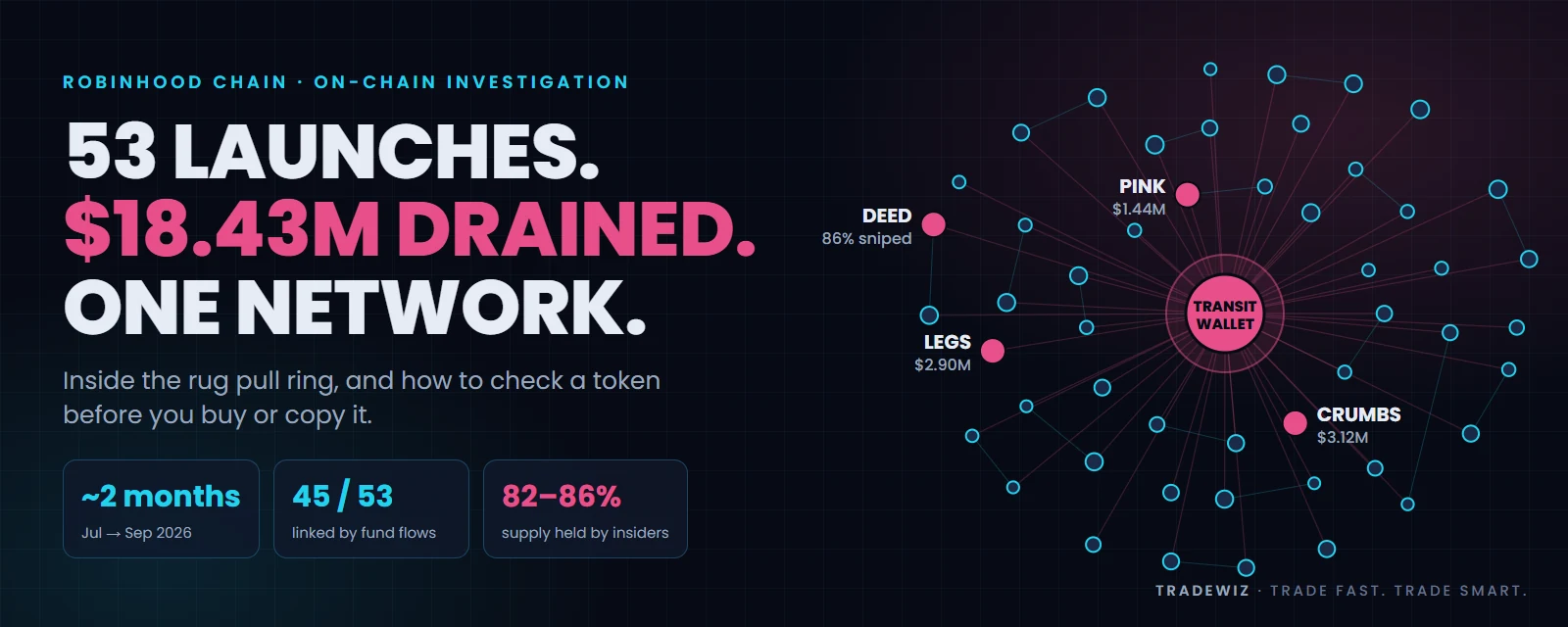
Robinhood Chain went live on mainnet on July 1, 2026, and almost immediately turned into a memecoin playground. New pools kept popping up, volume exploded, and everyone wanted in early.
But at the end of September, an on-chain analyst named Wazz published the results of a trace: 53 token launches over roughly two months were tied to the same group, and that group had pulled at least $18.43M out of buyers.
These weren't a handful of isolated rugs. This was an assembly line.
1. The key numbers
| Metric | Figure |
|---|---|
| Linked launches | 53 |
| Amount extracted (directly traced) | at least $18.43M |
| Timeframe | about 2 months (July – early September 2026) |
| Linked through fund flows | 45 / 53 launches |
| Shared transaction signing key | 4 launches |
| Shared collection wallet | 4 launches |
| Share of supply held by the group after launch | 82–86% |
Most of the launches happened on the Pons V2 launchpad, right in Robinhood Chain's hottest stretch. Wazz believes the real figure is even higher, since the $18.43M only covers funds Wazz could trace directly. Wazz also pointed to at least two other groups running a similar playbook that haven't yet been linked to this one.
2. A 5-step script, on repeat
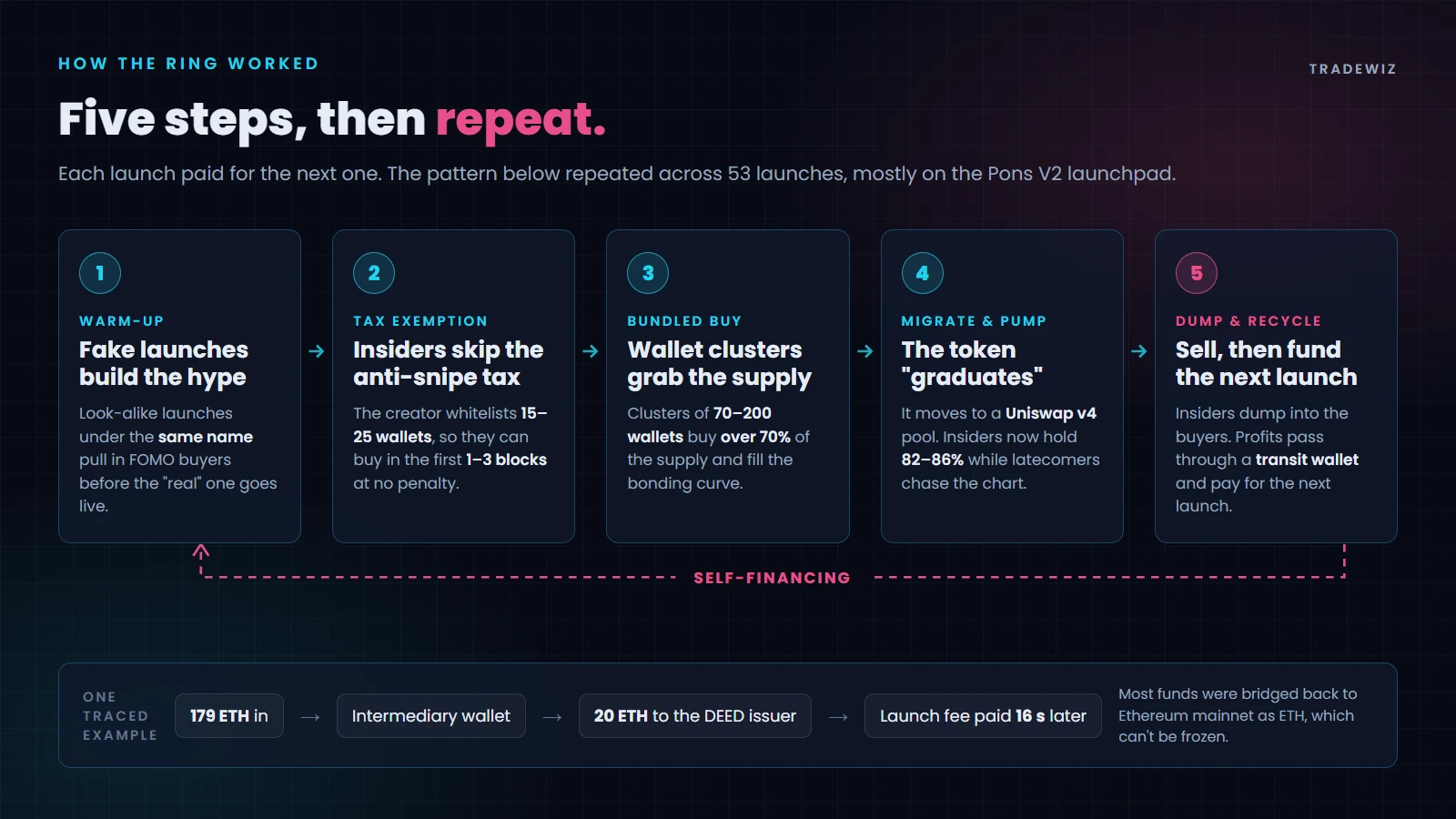
Step 1: Warm up with decoy launches. Before dropping the "real" token, the group launches a few tokens with the same name to pull in FOMO money. According to Wazz, CRUMBS, PINK and DEED all had decoy launches like this, and the "real" launch that followed got dumped all the same.
Step 2: Anti-snipe tax exemptions for insiders. Pons V2 has an anti-snipe tax to slow down bots in the first blocks. But in 9 cases, the token creator put 15–25 addresses on the tax-exempt list. Those wallets bought in the first 1–3 blocks without paying any penalty.
Step 3: Soak up supply with a wallet cluster. In almost every launch, a cluster of 70–200 wallets bought together and scooped up more than 70% of supply, filling the bonding curve.
Step 4: "Graduate" and pump. Once the bonding curve fills, the token migrates to a Uniswap v4 pool. At that point the creator and the exempt wallets hold 82–86% of supply, while latecomers see a green chart and jump in.
Step 5: Dump and reinvest. The group sells into latecomers' buying pressure. Profits pass through a relay wallet and flow straight into the deployer account for the next token. One traced example: 179 ETH went into an intermediary wallet, 20 ETH was sent to the DEED deployer address, and the launch fee was paid just 16 seconds later.
Most of the money was bridged back to Ethereum mainnet as ETH, which makes it nearly impossible to freeze.
3. Looking at the data
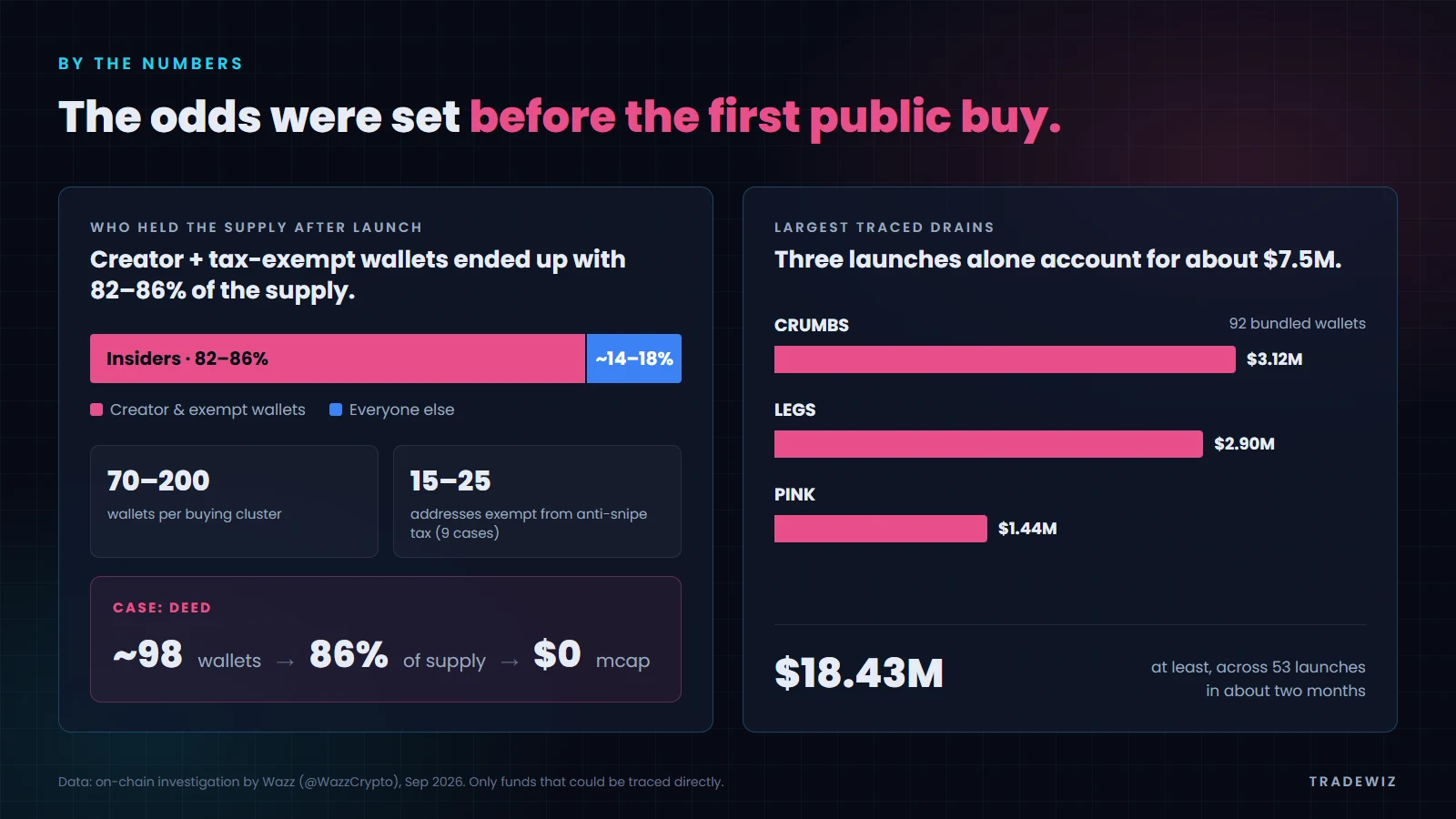
A few specific cases:
- CRUMBS: about $3.12M drained, using 92 accumulation wallets.
- LEGS: about $2.9M.
- PINK: about $1.44M.
- DEED: about 98 sniper wallets holding 86% of supply. After those wallets dumped, market cap went to zero. Notably, DEED didn't even make the top 10 by amount drained, yet it was the starting point of the investigation.
The first three cases alone account for about $7.5M.
4. Why speed can't save you here
We write a lot about execution speed. But this story exposes an important limit: speed decides where you stand in line, but it can't fix a line whose tickets were sold out before the doors opened.
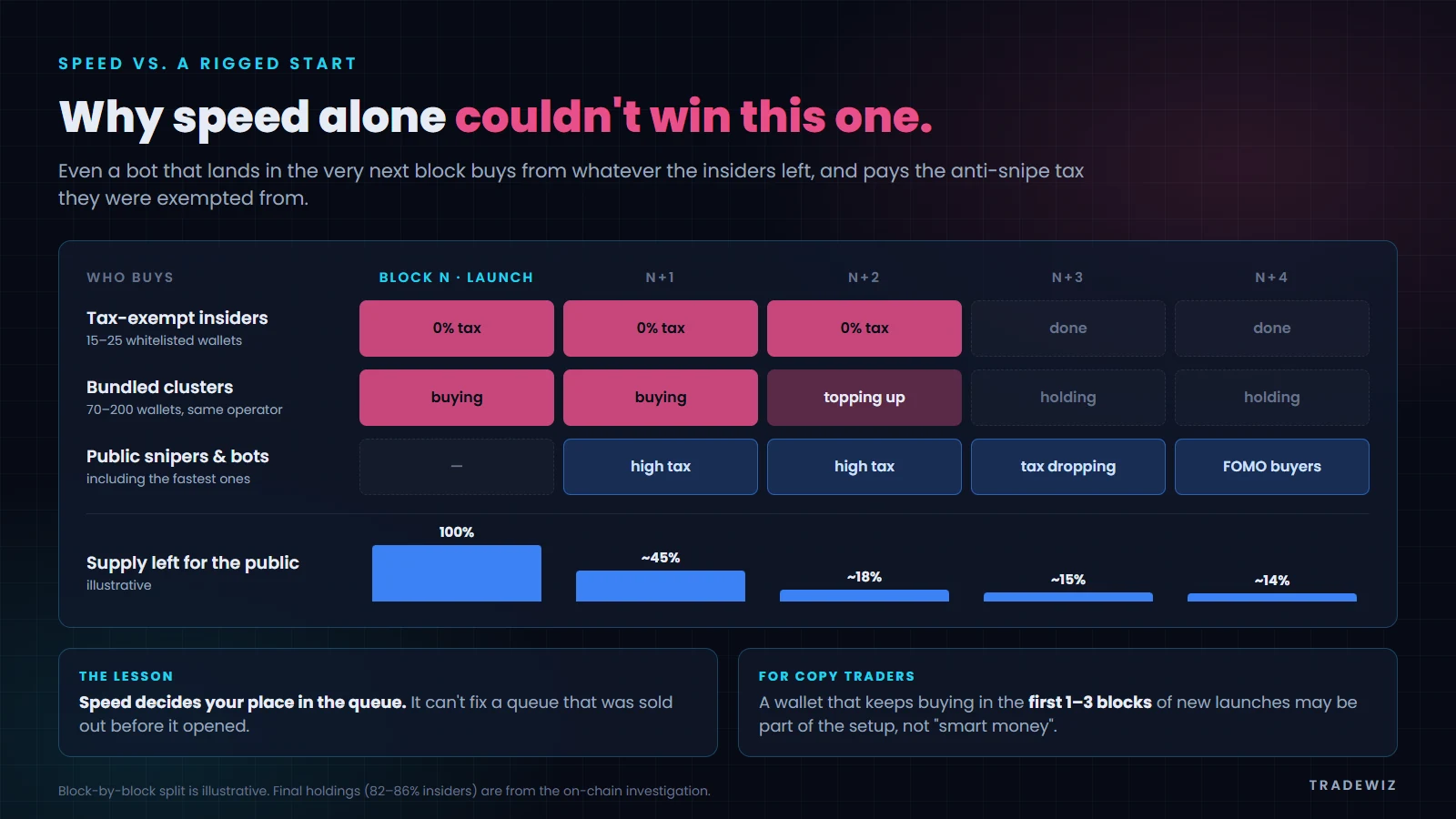
Even the fastest bot can only get in from the next block. By then:
- The tax-exempt wallets have already bought in block N at 0% tax.
- The group's wallet cluster has already scooped up most of the supply.
- You buy what's left, and pay the anti-snipe tax their insiders were exempt from.
You don't lose because you're slow. You lose because the game was rigged from the start.
5. A specific danger for copy traders
For copy traders, there's a subtler trap.
Wallets in the accumulation cluster often look a lot like smart money: extremely early entries, beautiful entry prices, high PnL. If you filter wallets on profit and entry speed alone, there's a good chance these exact wallets end up on your copy list.
The problem is you'll never get their entry price. They buy in the first block, tax-free. You buy after them, with tax, and become the exit liquidity they dump on.
A few warning signs to watch for in a wallet you plan to copy:
- Consistently buys in the first 1–3 blocks of newly launched tokens.
- Lots of "sibling" wallets buying the same token, at the same time, with nearly identical amounts.
- A history full of new tokens with short lifespans, whose charts all end at zero.
- A freshly created wallet, funded from the same source as many other wallets.
6. 8 checks before you buy, or copy
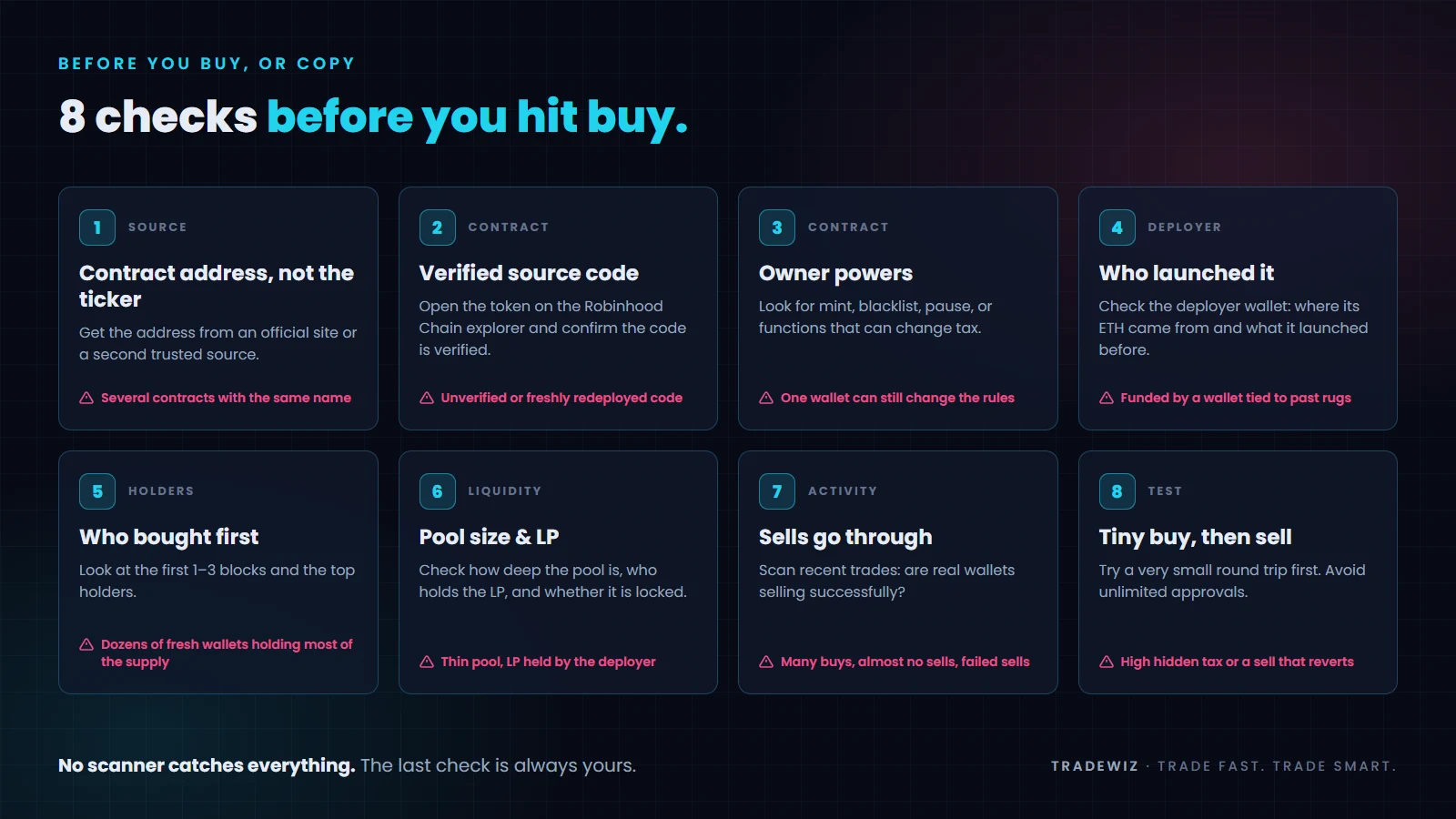
- Get the contract address, don't trust the ticker. Take the address from the official site or a second trusted source. Multiple tokens with the same name is the first warning sign.
- Check that the source code is verified. Paste the token address into the Robinhood Chain explorer (Blockscout) and see whether the code has been verified.
- Inspect owner permissions. Look for mint, blacklist, pause, or any function that can change the tax. If a single wallet can still change the rules, be careful.
- See who deployed it. Where did the deployer wallet get its ETH, what tokens has it launched before, and how did they end?
- See who bought first. Open the transactions in the first 1–3 blocks and the top holder list. Dozens of fresh wallets jointly holding most of the supply is a huge red flag.
- Check liquidity. Is the pool deep or thin, who holds the LP, and is the LP locked?
- See whether sells go through. Lots of buys but almost no successful sells, or sells that keep failing, is a classic honeypot sign.
- Do a tiny test buy, then a test sell. Run a full buy-and-sell round trip with a very small amount first. Avoid granting unlimited approvals, and revoke old approvals regularly.
Audits help, but they're not a shield. Audited projects have rugged all the same.
7. A more defensive copy trade setup
No setting removes risk entirely, but you can limit the damage if you accidentally copy into a bad token:
- Cap the amount per trade (Max Buy). Each new token should take up only a small slice of your capital.
- Set a minimum token age and market cap if you don't want to dive into the first blocks of every launch.
- Always use TP/SL. With new tokens, the goal is to survive first and profit second.
- Review your copy wallet list against the signs in section 5, don't just look at PnL.
- Turn on the anti-rug layer if your bot has one. TradeWiz upgraded anti-rug for Robinhood FOMO in September, but it's a filter, not a promise of zero risk.
The bottom line
This 53-token ring reveals an uncomfortable truth: in staged launches, public buyers have already lost before their first order is even sent.
Speed still matters. But before asking "how fast can I get in," ask "what am I getting into, and who got in before me."
Check first. Then be fast.
Trade Fast. Trade Smart.
Note: The figures in this article are based on the public on-chain trace results from analyst Wazz (September 2026). On-chain data shows links between wallets, but on its own it is not enough to establish the legal liability of any individual. This article is for informational purposes only and is not investment advice.