How to Snipe New Pump.fun Tokens the Right Way in 2026
 2026-10-0910 min read
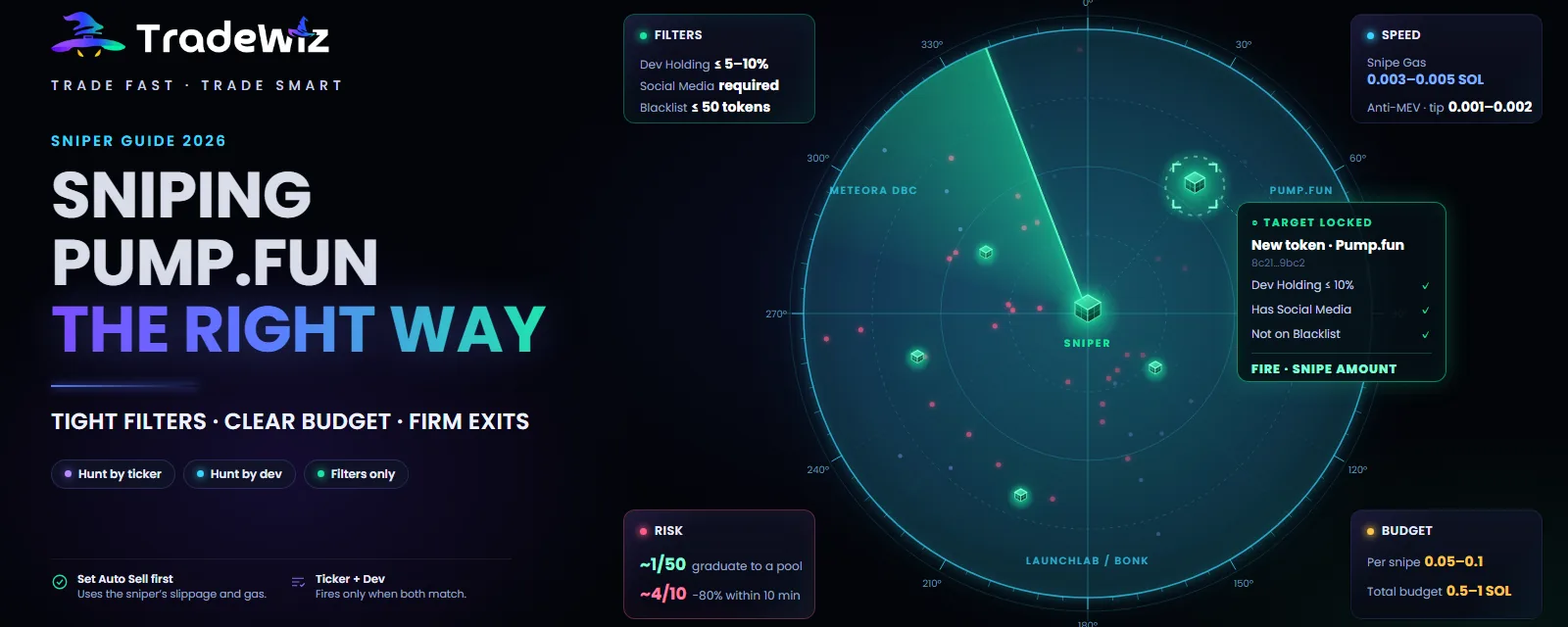
In October 2026, Pump.fun is buzzing again: tens of thousands of new tokens a day and surging trading volume. Every wave like this brings a wave of people who want to "snipe", meaning buy a token in its first few seconds in the hope of catching a 50x.
The truth few people mention: sniping is the strategy with the most volatile results in memecoin trading. Most tokens die within minutes. The snipers who make a net profit aren't the fastest shooters, they're the ones with the tightest filters, the clearest budget and the most disciplined exits. This post covers all three.
Quick summary
- According to public on-chain stats, only about 1 in 50 Pump.fun tokens completes its bonding curve and moves to its main pool. Of those, nearly 4 in 10 drop 80% in the first 10 minutes.
- Never snipe without filters. At a minimum: cap dev holding, require social media, pick specific platforms.
- A fixed budget for each sniper config. When it's gone, you stop, with no topping up that day.
- Set up Auto Sell before turning on the sniper. Sell orders use the same slippage and gas you set in the sniper config.
The lifecycle of a Pump.fun token and where snipers get in
Stage 1: Token creation
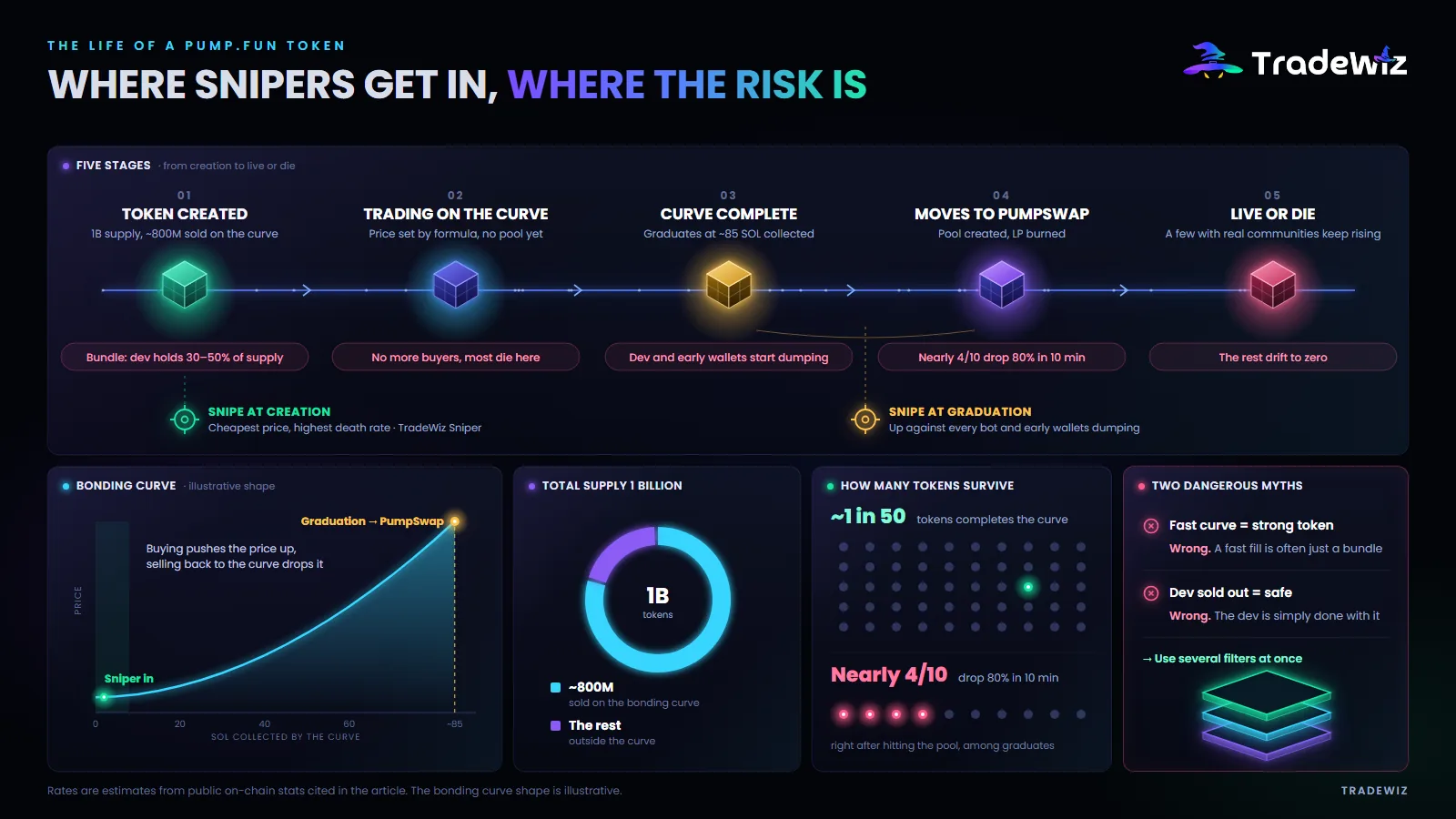
Every Pump.fun token has a total supply of 1 billion, of which about 800 million are sold on the bonding curve. The dev can buy in the very first block, often with many wallets at once. This is called a bundle. If the dev and related wallets hold 30–50% of the supply from the start, everyone who buys after becomes their exit liquidity.
Stage 2: Trading on the curve
The price rises along a fixed formula when people buy and falls when people sell back to the curve. There's no liquidity pool, so there's no "pulling liquidity" at this stage. The risk is that nobody keeps buying and you have to sell back to the curve at a low price. Most tokens die here, never leaving the curve.
Stage 3: Curve completes
Once the curve has collected about 85 SOL, the token graduates. This is the moment most bots hunt for, because the token has proven there are buyers. But it's also when the dev and early wallets start dumping.
Stage 4: Moving to PumpSwap
The SOL from the curve is used to create a pool on PumpSwap, Pump.fun's own decentralized exchange. The LP is burned, so liquidity can't be pulled. Free trading begins. Data from thousands of graduated tokens shows that nearly 4 in 10 drop 80% in their first 10 minutes on the pool.
Stage 5: Live or die
A small number of tokens with a real community keep rising for hours or days. The rest drift to zero.
Two ways to snipe
- Sniping at creation. Buy in the first few blocks on the curve. The cheapest price and the highest death rate. Filters are mandatory.
- Sniping at graduation. Buy as soon as the pool opens. The token has already passed a round of natural selection, but you're competing with every other bot and with early wallets that are dumping.
The TradeWiz sniper focuses on the first approach across three platforms: Pump.fun, Launchlab/Bonk and Meteora DBC.
Two dangerous misconceptions
"A curve that fills fast means a strong token." Not true. Stats across thousands of tokens show that tokens that complete their curve in seconds and tokens that fill slowly crash at almost the same rate after moving to a pool. A fast fill is often just the dev's bundle.
"The dev has sold everything, so it's safe." Also not true. Tokens where the dev dumped below 5% before graduating actually have a higher rate of deep drops than those where the dev still holds. A dev who sold everything usually means the dev is done with that token.
Conclusion: no single signal is reliable enough. You need several filters at once.
Filters in the TradeWiz Sniper
| Filter | What it does | Suggestion |
|---|---|---|
| Platforms | Which platforms to watch | Pick 1–2 platforms you understand well, not all of them |
| Dev Holding | The share of supply the dev can hold that you'll accept | Max 5–10% |
| Social Media | Whether the token has social media links | Require it, to filter out auto-generated tokens |
| Ticker | The token name to catch | Use it when a narrative is hot |
| Method | Exact only catches the exact name, Contains catches any name containing the keyword | Contains is wider but brings more junk |
| Dev | Dev wallet address | Only catch tokens created by this wallet |
| Blacklist | Tokens not to snipe | Up to 50 tokens, for junk tickers that keep coming back |
Important note: when you set both Ticker and Dev, the sniper only fires when both conditions are met.
Sample settings for small capital
| Setting | Starting value | Why |
|---|---|---|
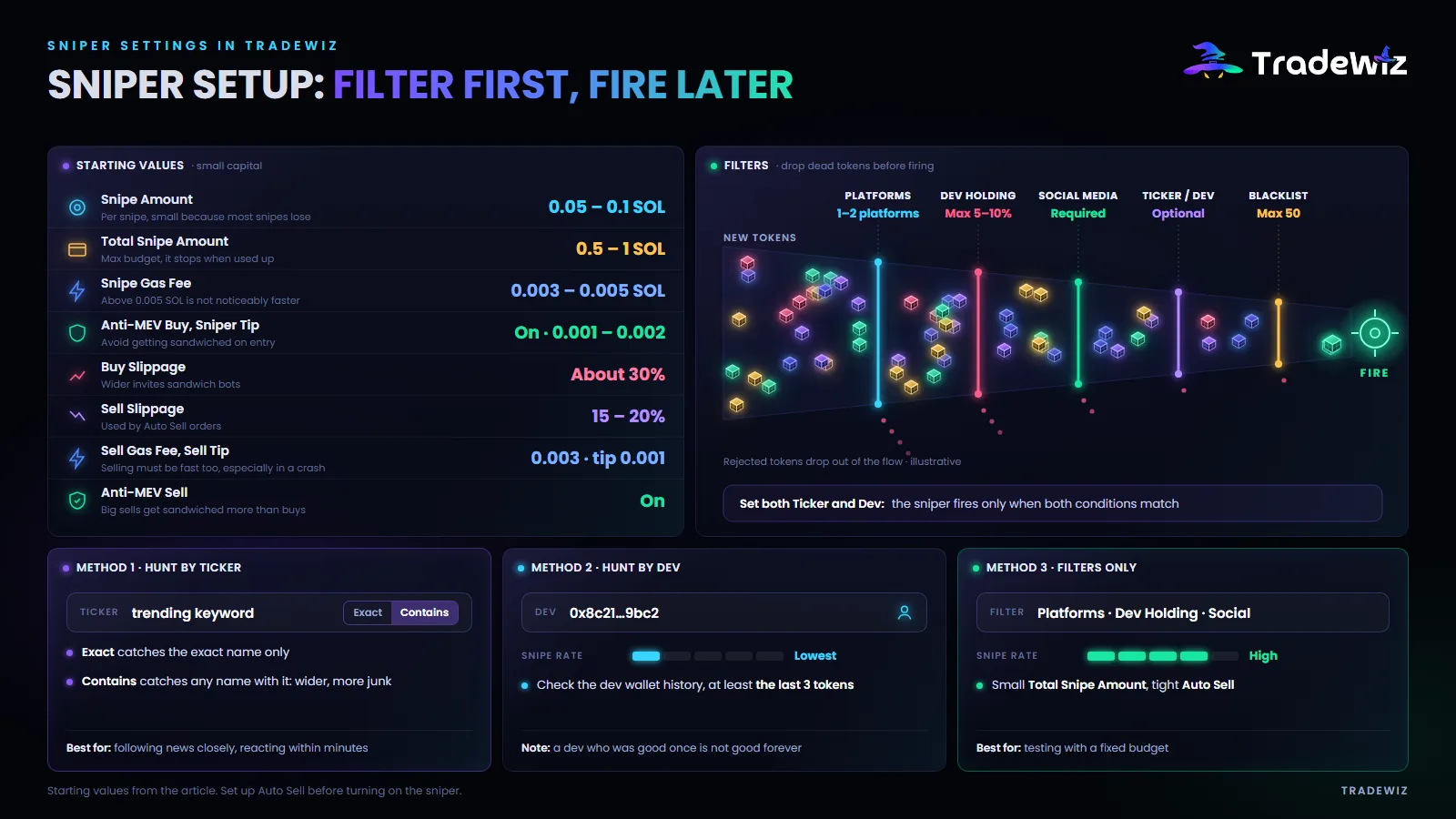
| Snipe Amount | 0.05 – 0.1 SOL | The amount per snipe. Small, because most snipes will lose |
| Total Snipe Amount | 0.5 – 1 SOL | The config's maximum budget. When it's gone, it stops |
| Snipe Gas Fee | 0.003 – 0.005 SOL | Higher than copy trading because you're fighting for the first block. Above 0.005 SOL, you don't get noticeably faster |
| Anti-MEV Buy, Sniper Tip | On, tip 0.001 – 0.002 SOL | Avoid getting sandwiched right as you enter |
| Buy Slippage | Around 30% | New token prices jump hard between sending and filling. Don't go higher, wide slippage is an invitation to sandwich bots |
| Sell Slippage | 15 – 20% | Used for Auto Sell orders |
| Sell Gas Fee, Sell Tip | 0.003 SOL, tip 0.001 SOL | Sells need to be fast too, especially when the token crashes |
| Anti-MEV Sell | On | Large sells are easier to sandwich than buys |
Three things to remember:
- A small Snipe Amount isn't about being timid. With a low win rate, small trade sizes are the only way to survive losing streaks and still have capital when the big winner shows up.
- Total Snipe Amount is a hard line. Once it's set, don't change it during the day.
- Every sell setting in the sniper config is used for automatic sells. Get the sell slippage wrong and your exit won't fill exactly when you need it most.
Three ways to use the sniper
Method 1: Hunt by ticker
When a narrative is hot on X, hundreds of copycat tokens get created within hours. Set Ticker to that keyword. Choose Contains to catch every token containing the keyword, or Exact to only catch the exact name. Combine it with Dev Holding and Social Media to filter out junk.
A good fit when you follow the news closely and can react within minutes.
Method 2: Hunt by dev
Some devs launch successful tokens again and again. Enter their wallet address in the Dev field. The sniper only fires when that exact wallet creates a new token. This is the most selective method, with the lowest snipe frequency.
Note: a dev who did well once won't necessarily do well forever. Many devs use the reputation of a previous token to dump the next one. Review the dev wallet's history for at least its 3 most recent tokens.
Method 3: Filters only
No ticker, no dev. Let Platforms, Dev Holding and Social Media do the work. Snipe frequency is high, so Total Snipe Amount has to be small and Auto Sell has to be tight. A good fit for experimenting with a fixed budget and learning how the market works.
An exit plan for freshly sniped tokens
Sniping without an exit plan is giving money away. New tokens move too fast to sell by hand. Before turning on the sniper, set up Auto Sell:
- Take profit in steps: price up 100% sell 50%, up 200% sell 25%, and let the rest run with a 25–30% Trailing Stop.
- Stop loss: price down 40–50% sell everything. For new tokens, the stop loss needs to be wider than usual because the natural volatility is huge, but it must never be left empty.
How to set up each tool is covered in Memecoin take profit: Auto Sell, Trailing Stop or Limit Order.
Realistic expectations
Let's run the numbers on a week of sniping with the settings above: 100 snipes, 0.05 SOL each, 5 SOL in total. A common scenario:
- 60 snipes lose 50–80%, losing about 2 SOL.
- 30 break even or make a small profit, returning about 1.6 SOL.
- 8 make 2–3x, returning about 1 SOL.
- 2 make 10x or more, returning 1–2 SOL or more.
The total comes back to 5.6–6.6 SOL, a 12–32% profit before fees, and all of the profit comes from the 2 big wins. If you sell those two early out of fear, the whole week is a loss. If you drop your filters to snipe more, your losses grow faster than your wins.
That's the nature of sniping: profit comes from a few, and discipline decides whether you hold on to those few.
FAQ
Is the sniper faster than copy trading?
They have different purposes. The sniper reacts to a token creation event, copy trading reacts to a wallet's trade. The sniper needs higher gas because it's fighting for the first block against lots of other bots.
Should I snipe at graduation?
You can, but it's a different game: you're competing with early wallets that are dumping. If you want to, treat it as a regular buy with tight Auto Sell, not as a snipe.
Why didn't the sniper fire even though a token matched?
Check: whether Total Snipe Amount has run out, whether the token is on your Blacklist, whether setting both Ticker and Dev made the conditions too narrow, and whether your wallet balance covers Snipe Amount plus gas and tip.
Key takeaway
Sniping new tokens isn't a speed game, it's a probability game. Filters help you rule out most dead tokens before you fire. A fixed budget keeps you alive through losing streaks. Auto Sell turns a few big winners into real profit instead of paper gains.
Every setting is described in the Sniper guide. Start with TradeWiz, a 0.5 SOL budget and filters tighter than you think you need.
Trade Fast. Trade Smart.