AI Memecoin Trading Bot: Build One or Copy Trade? (2026)
 2026-11-2210 min read
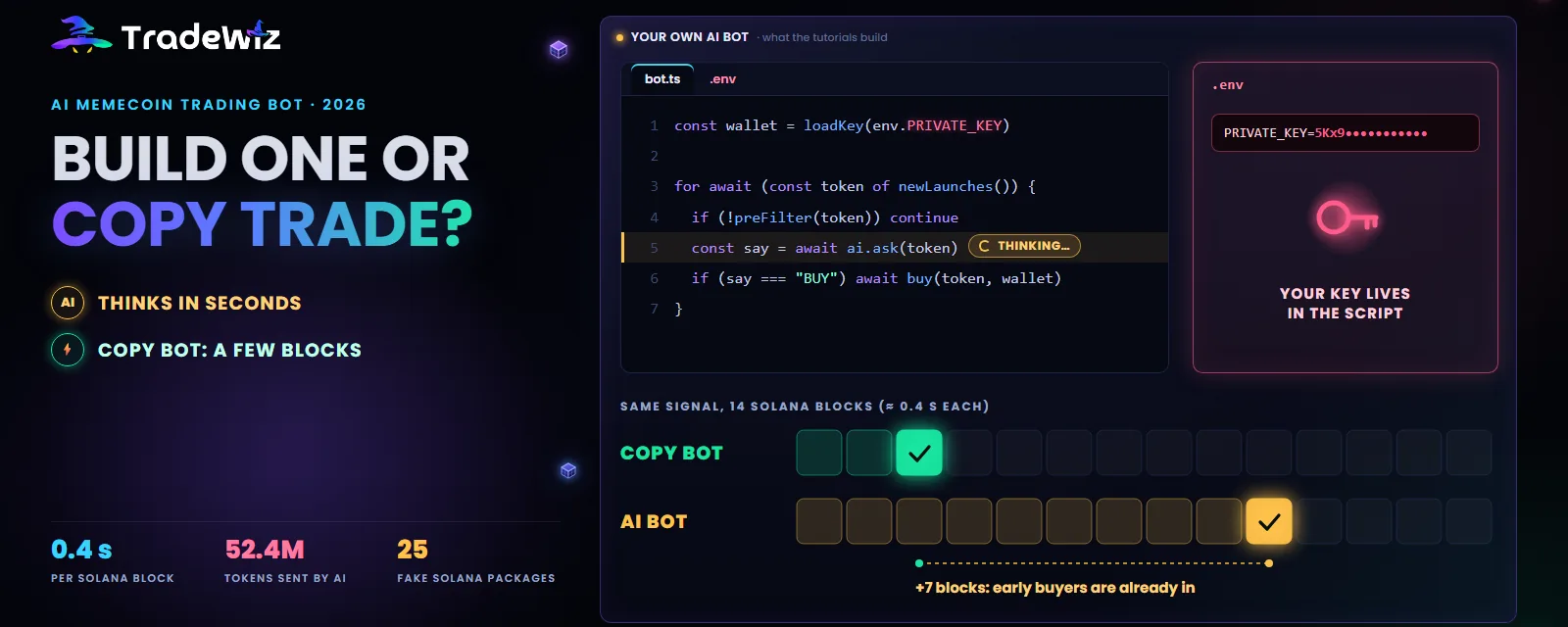
"Build an AI trading bot with Claude" is one of the biggest trends on YouTube this year. Tutorials that build one with Claude Code or Grok pull hundreds of thousands of views each, and many of them end with the same promise: let the AI trade memecoins for you while you sleep. So should you build your own AI memecoin trading bot, or just copy trade with a bot that already exists? For fast Solana memecoins, copy trading wins on speed, cost and wallet safety for almost everyone. AI is still useful, just not as the thing that clicks buy. Below we show where a self-built AI bot falls behind, three real cases where AI and "free bot" code cost people their wallets, and a setup that uses AI where it actually helps.
Quick summary
- An AI model needs from under a second to several seconds to answer. A Solana block takes about 0.4 seconds, so an AI that decides every trade arrives several blocks late.
- A self-built bot also has to land the trade: priority fees, retries, slippage and an RPC feed that doesn't drop. Copy bots already do this.
- To trade on its own, any bot must hold your private key. In 2026 an AI agent sent away its whole token stack, and fake Solana bot code on GitHub, npm and PyPI stole keys.
- Best use of AI: check wallets, read token data and review your trade log. Let a copy bot place the trades.
What people mean by an "AI memecoin trading bot"
The phrase covers three very different things, and the risks are not the same.
| Type | What the AI does | Example |
|---|---|---|
| AI-written bot | Writes the code; the bot then follows fixed rules | Asking Claude Code to build a Pump.fun sniper |
| AI-decision bot | Reads each new token and answers buy or skip | A script that sends every new launch to Claude or Grok |
| Autonomous AI agent | Has its own wallet and acts on its own, including transfers | Lobstar Wilde (see below) |
The first type is just a normal trading bot that you wrote faster. It is as good as your rules, your infrastructure and your code review. The second and third types put a language model in the trade loop, and that is where most of the problems start.
Where a self-built AI bot falls behind on Solana
Speed: the AI thinks in seconds, Solana moves in 0.4
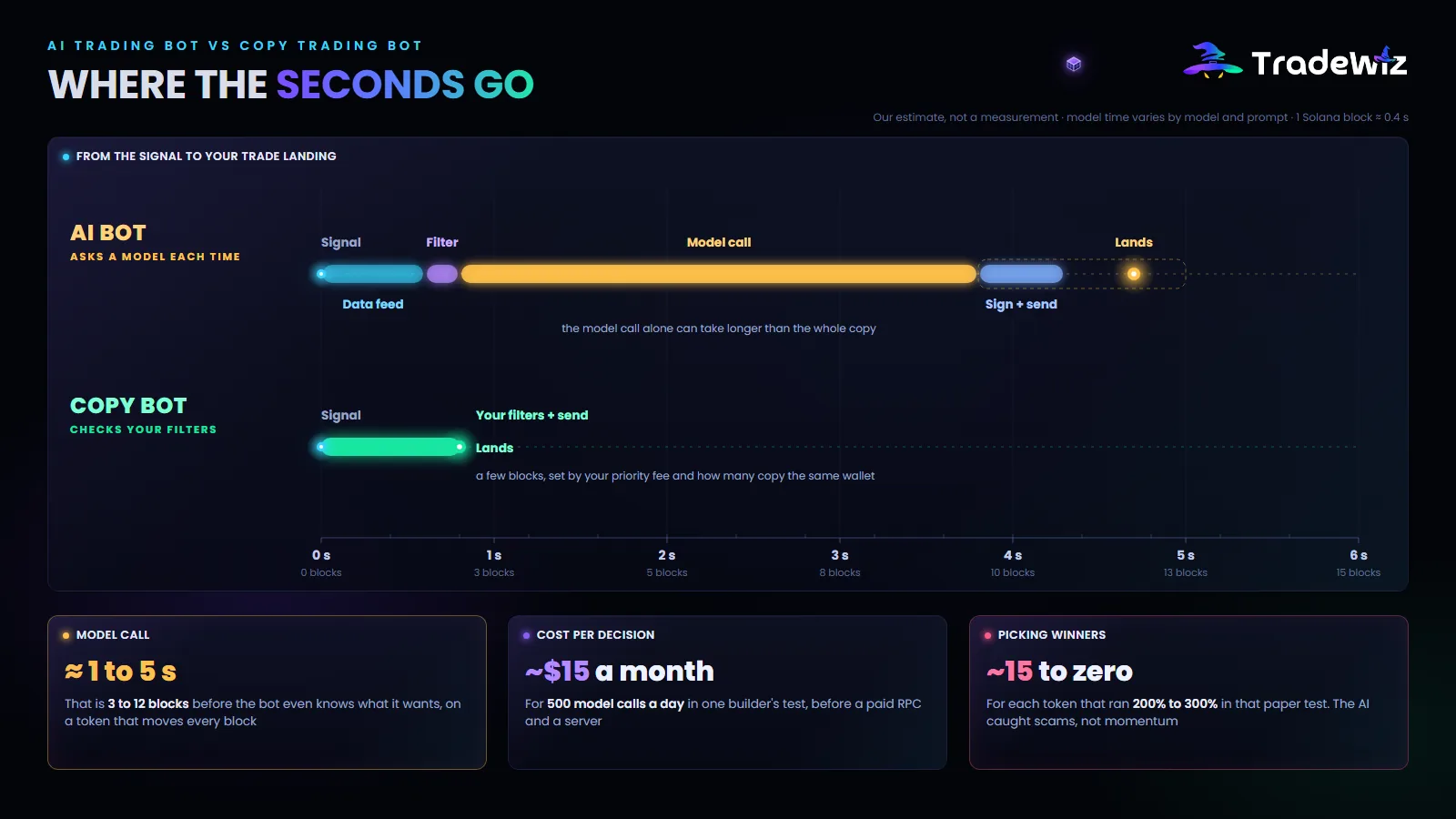
On Solana a new block comes about every 0.4 seconds. A call to a model like Claude or Grok usually takes from under a second to several seconds, depending on the model and how much data you send it. That is several blocks before your bot even knows what it wants to do. Then it still has to build, sign and send the transaction.
On a fresh memecoin, those blocks are the trade: early buyers push the price up, and you buy their exit. Our article on where copy trade speed is actually lost breaks that pipeline down; an AI decision adds one more slow step.
A copy bot skips the thinking. You already chose the wallet and the rules, so when the wallet buys, the bot checks your filters and sends your buy, usually within a few blocks. How close it lands depends on your priority fee and how many others copy the same wallet.
Landing the trade is its own job
Deciding is half of it. A trade also has to land, and on busy memecoins that takes work that tutorials rarely cover:
- Priority fees and tips. Set too low, your transaction waits while others go first.
- Slippage. Too tight and the buy fails; too loose and you overpay or get sandwiched by MEV bots.
- Retries. When a buy fails on slippage, someone has to decide whether to try again, and at what price.
- Pump.fun quirks. On the bonding curve the token amount is fixed and the SOL you spend rises with the price, so a buy can cost more than you planned.
Copy trading bots ship with settings for all of this. In TradeWiz's copy trading guide, for example, you'll find MEV protection, Auto Retry, a separate PUMP Slippage and a slippage that is measured from the copied wallet's own price. On your own bot, each of those is code you write, test and fix.
Data and uptime
A bot is only as fast as its data. One developer who built a Solana memecoin bot with Claude Haiku as the decision layer wrote up what happened:
- The free Helius tier kept dropping the WebSocket, and the bot stopped silently until he added reconnect logic.
- Pump.fun changed its API several times without notice; some nights the bot got no data at all.
- By the time the free-tier data arrived and the bot acted, early buyers had already moved the price.
His verdict: he would build it again, but would not run it with real money on the free tier. Fixing that means a paid RPC, a server running 24/7 and you on call when it breaks.
Cost per decision
An AI bot pays for every token it looks at, not just the ones it buys. The same builder kept costs to about $15 a month at 500 calls a day, and only because simple filters (creator holding, liquidity, token age) threw out most launches before they reached the model. Add a paid RPC and a server, and you pay a monthly bill before your first trade. A copy bot usually charges nothing until you trade, then a fee per trade, often around 1%. Network fees apply either way. Our breakdown of Solana copy trading fees shows how they add up on small trades.
Does the AI pick winners?
Not reliably. In the same paper-trading test, Claude caught the most obvious scams but could not predict momentum or influencer-driven pumps. A few tokens ran 200% to 300% in an hour; for each of them, roughly fifteen went to zero within minutes. A model can read a token's data. It can't see who is about to buy it.
The bigger risk: your private key
Speed and cost lose you money slowly. The key can lose it all at once. Any bot that trades on its own has to sign transactions, so it needs your wallet's private key, usually in a .env file on your computer or server. That makes your bot, the code it runs and every package it installs part of your wallet's security.
Case 1: an AI agent sent away its whole token stack
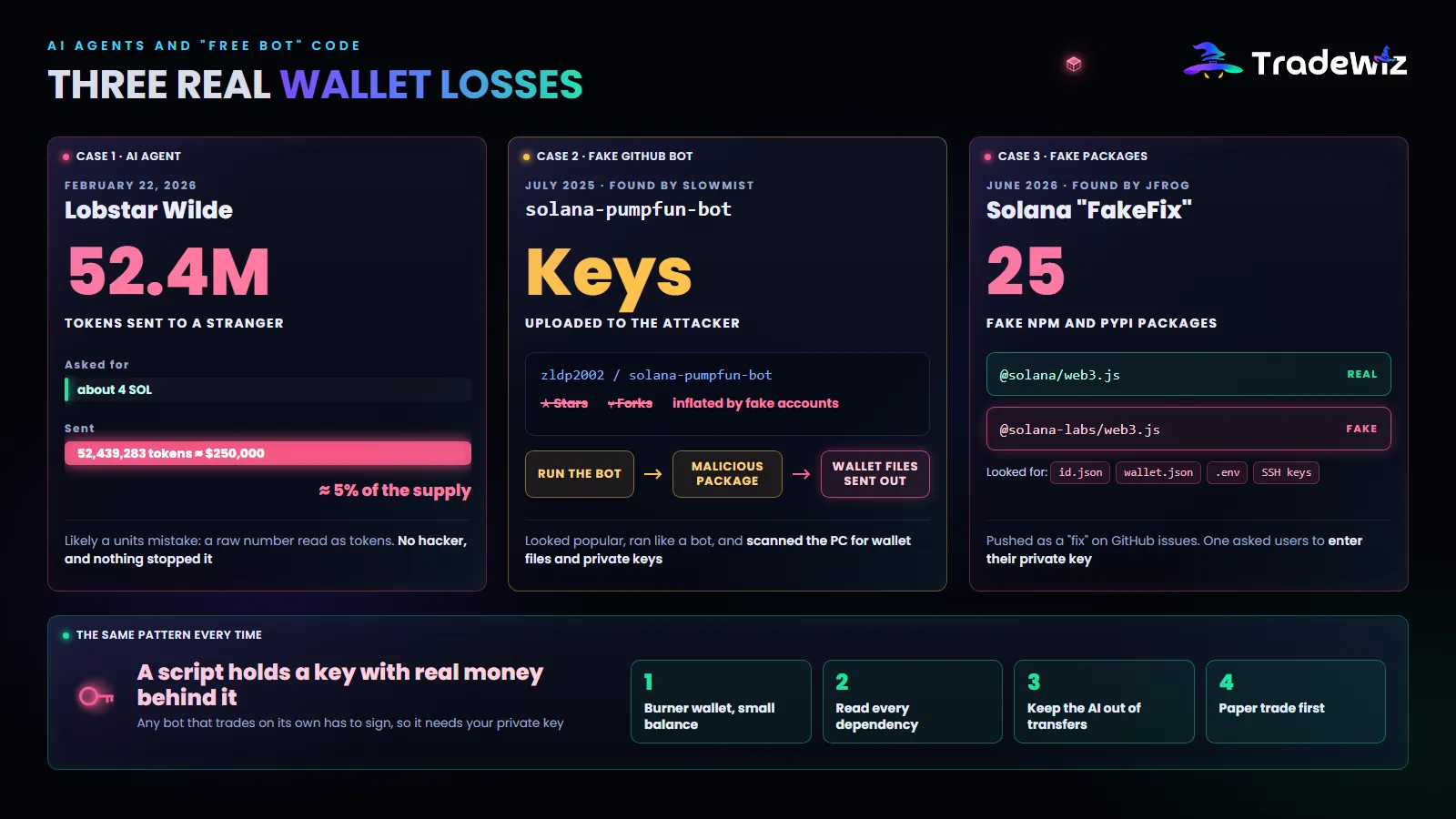
On February 22, 2026, Lobstar Wilde, an experimental AI agent with its own Solana wallet, sent its entire LOBSTAR holdings to a stranger on X. The person had asked for about 4 SOL. The agent sent about 52.4 million tokens, 5% of the supply, worth roughly $250,000 at the time. The likely cause was a units mistake: the agent appears to have read a raw number from an API as 52.4 million instead of 52,439. The recipient sold within about 15 minutes for around $40,000.
No hacker was involved. The AI made one wrong move with real funds, and nothing stopped it.
Case 2: a "Solana Pump.fun bot" on GitHub that stole wallets
In July 2025, security firm SlowMist traced a theft to a GitHub repository called solana-pumpfun-bot. It looked popular, with plenty of stars and forks, but those were inflated by accounts the attacker controlled. The bot pulled in a malicious package from the attacker's own GitHub, which scanned the victim's computer for wallet files and private keys and uploaded them. The victim ran the bot, and the funds were gone.
Case 3: 25 fake packages aimed at Solana developers
In June 2026, JFrog reported a campaign of 25 malicious npm and PyPI packages, 20 of them aimed at Solana developers. They used names close to real tools, such as @solana-labs/web3.js instead of @solana/web3.js, and posts on GitHub issues pushed them as a "fix". Once installed, they looked for Solana keypair files, .env files and other secrets. One, solana-mev-bot, simply asked users to enter their private key to "start earning".
The pattern is the same every time: a bot, a script or an AI agent holds a key with real money behind it.
If you build one anyway
- Use a new burner wallet with only what you can afford to lose, never your main wallet's key.
- Check every dependency: the exact package name and publisher. Never run trading code from GitHub, Telegram or YouTube you haven't read, and never on the computer that holds your main wallet.
- Keep the AI out of transfers. Let it say buy or skip; hard-code the maximum size where it can't change it.
- Paper trade first, for weeks.
Our 10 rules to keep your wallet safe with trading bots apply to any bot, including one you write yourself.
Build vs copy trade: side by side
| Build your own AI bot | Copy trade with a bot | |
|---|---|---|
| Setup | Days to weeks, then ongoing fixes | Minutes: paste a wallet, set size and filters |
| Reaction time | Data feed + model call + your transaction code: often seconds | Usually a few blocks after the wallet's trade |
| Landing trades | You code priority fees, slippage and retries | Built-in settings for fees, MEV protection, retries and slippage |
| Monthly cost before trading | Model API, paid RPC, a server | Usually none; a fee per trade, often around 1% |
| Private key | Sits in your script, on your machine | Held by the bot; you keep only trading money there |
| Who decides the buy | A model that can't see who buys next | A wallet you chose and checked, inside your rules |
| Best for | Learning, research, alerts, paper trading | Trading real money on fast memecoins |
Neither side is risk-free. A copy bot also holds a key, and bots have been hacked; that's why our copy trading bots page ranks them on security. But you trust one team whose business is that key, not your weekend code and every package it pulls in.
Where AI actually helps a memecoin trader
AI is slow at clicking but very good at reading. Use it where speed doesn't matter.
- Checking wallets before you copy. Paste a wallet's trade history into Claude, ChatGPT or Grok and ask for average hold time, win rate over 30 days, how often it buys in the first block and how big its losers are. That flags snipers and one-hit wallets. Our guide to finding smart money wallets worth copying lists what to look for.
- Reading a token before you buy. Give it the holder list, the creator's history and the liquidity, and ask for red flags. Then check them yourself with our rug pull checklist.
- Reviewing your own trades. Export your copy trade history once a week and ask which wallets, sizes or market caps lost you money. Most traders who lose while copying a winning wallet lose on entry price and exits, as we show in why you lose copying a winning wallet.
- Read-only scripts. If you like building, have the AI write alert scripts that watch wallets or tokens and message you. They need no private key, so a bug costs you nothing.
A setup that works: AI picks the wallets, a copy bot trades
- Collect candidates. Pull wallets from leaderboards and from tokens that ran.
- Let the AI screen them. Ask it to score each wallet on hold time, consistency and drawdown, and drop anything that looks like a sniper or a bundle.
- Copy the best three to five on a copy trading bot. Start small: in TradeWiz's copy trading settings, that means a low Buy Percentage, a Max Buy and a SOL Spending Limit per wallet.
- Add your filters. Min LP, Max and Min Market Cap, and skipping tokens with Unrenounced ownership or Unburned LP keep you out of the worst launches.
- Plan the exit. Turn on Copy Sell, or set your own take profit, stop loss or trailing stop.
- Review weekly with AI. Feed it your results, cut the wallets that lose and test new ones.
The AI does the slow thinking once a week. The bot does the fast part every block.
FAQ
Can Claude, ChatGPT or Grok trade memecoins for me?
Not by themselves. A chat model can't sign transactions. You need code that connects it to a wallet and a data feed, and that code has to hold your private key.
Is an AI memecoin trading bot profitable?
There's no evidence that an AI deciding each trade beats a simple rule set on memecoins. It reacts seconds late, pays for every decision, and can't predict momentum. Most public builds report paper trading results, not real profits.
Is it safe to give an AI trading bot my private key?
Only a burner wallet with money you can afford to lose. An AI agent can make a mistake with real funds, as Lobstar Wilde did, and the code around it can be malicious if you copied it from an unknown repo or package.
Are free Solana trading bots on GitHub safe?
Many are not. SlowMist and JFrog have both found fake Solana trading bots and SDK packages that steal private keys. Stars and forks can be faked. Don't run one unless you have read every line and every dependency.
Is AI better than copy trading?
For placing trades on fast memecoins, no: copy trading is faster, cheaper to run and simpler to secure. AI is better at what comes before and after the trade: checking wallets, reading tokens and reviewing results.
Key takeaway
Building an AI memecoin trading bot is a great way to learn, and a poor way to trade real money. The AI reacts in seconds when Solana moves in 0.4, every decision costs money, and the bot has to hold your key. Use AI to choose and review wallets, and let a copy trading bot do the buying and selling.
Compare 20+ bots on security, fees and copy trading on our copy trading bots page. To start right away, TradeWiz on Telegram has every copy setting above, explained in our Copy Trading guide.
Trade Fast. Trade Smart.
Some links are referral links: you pay no extra fees, and we may earn part of the trading fees. Sources: The Block, Cointelegraph (SlowMist), JFrog Security Research and a DEV Community build log, checked on November 22, 2026. Nothing here is financial advice; memecoin trading is high risk, only trade money you can afford to lose.