Solana Copy Trading Fees: 1% Is Just the Tip of the Iceberg
 2026-08-318 min read
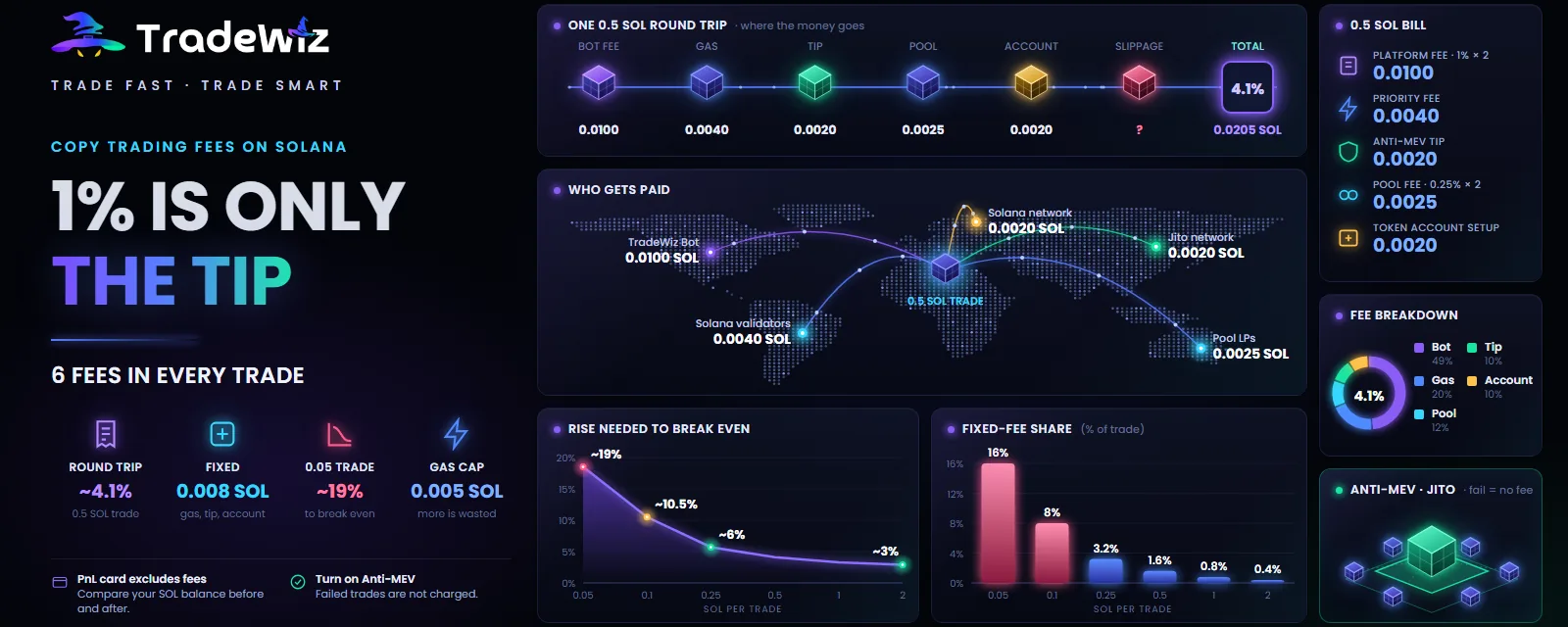
Most bots on Solana advertise one number: 1%. Some say 0.5%. Users compare those two numbers and think they've compared fees. In reality, the platform fee is just one of six costs you pay on every trade, and on small trades it isn't even the biggest one.
This post adds up every cost with real numbers, so you know how much a token has to rise before you break even, and which costs you can actually cut.
Quick summary
- A 0.5 SOL buy-and-sell round trip costs about 0.02 SOL, or roughly 4%, before slippage.
- Three costs are fixed per trade (gas, tip, token account creation) and stay the same whether the trade is big or small. A 0.05 SOL trade needs the token to rise almost 19% just to break even.
- The PnL card in the bot doesn't subtract these costs. Check against your SOL balance before and after.
- The most effective way to cut fees isn't switching to a cheaper bot. It's raising your minimum trade size and reducing failed trades.
6 costs on every trade
1. Platform fee
TradeWiz charges 1% on every buy and every sell. A round trip is 2%. This is the only cost that scales fully with the amount, and it's clearly stated.
A note when comparing with other bots: many platforms advertise 0.5% but attach conditions around volume, referral codes or cashback programs. Look at the number after your own conditions are applied.
2. Priority fee
Also called gas. You pay validators so your transaction is placed early in the block. It's fixed per trade, not per amount. Suggested: 0.002–0.003 SOL per trade. Above 0.005 SOL, you don't get noticeably faster.
One round trip: about 0.004 SOL.
3. Anti-MEV tip
Only applies when you turn on Anti-MEV. Your transaction is sent through a private channel on the Jito network so sandwich bots can't see it coming. The tip is also fixed per trade. The key point: with Anti-MEV on, failed trades aren't charged a fee.
Assuming a 0.001 SOL tip each way, one round trip: 0.002 SOL. The actual tip is up to you.
4. Pool fee
The fee of the decentralized exchange where the token is swapped, paid to liquidity providers. Usually 0.25–1% depending on the pool. You pay it whether you use a bot or swap yourself from a wallet.
One round trip on a 0.25% pool: about 0.0025 SOL on a 0.5 SOL trade.
5. Token account creation fee
The first time you buy a token, the Solana network charges 0.002 SOL to open an account that holds that token in your wallet. Once per new token. For a copy trader hitting 20 different tokens a day, that adds up to 0.04 SOL a day.
6. Slippage and price impact
Not a fee in the literal sense, but the biggest and least visible cost. Slippage is the difference between the price when you send the trade and the price you actually get filled at. Price impact is how much your own trade pushes the price up. On thin-liquidity tokens, these two can be bigger than the other five costs combined.
There's no fixed number. You control it with slippage settings, trade size relative to the pool, and how fast you get in.
The bill for a 0.5 SOL round trip
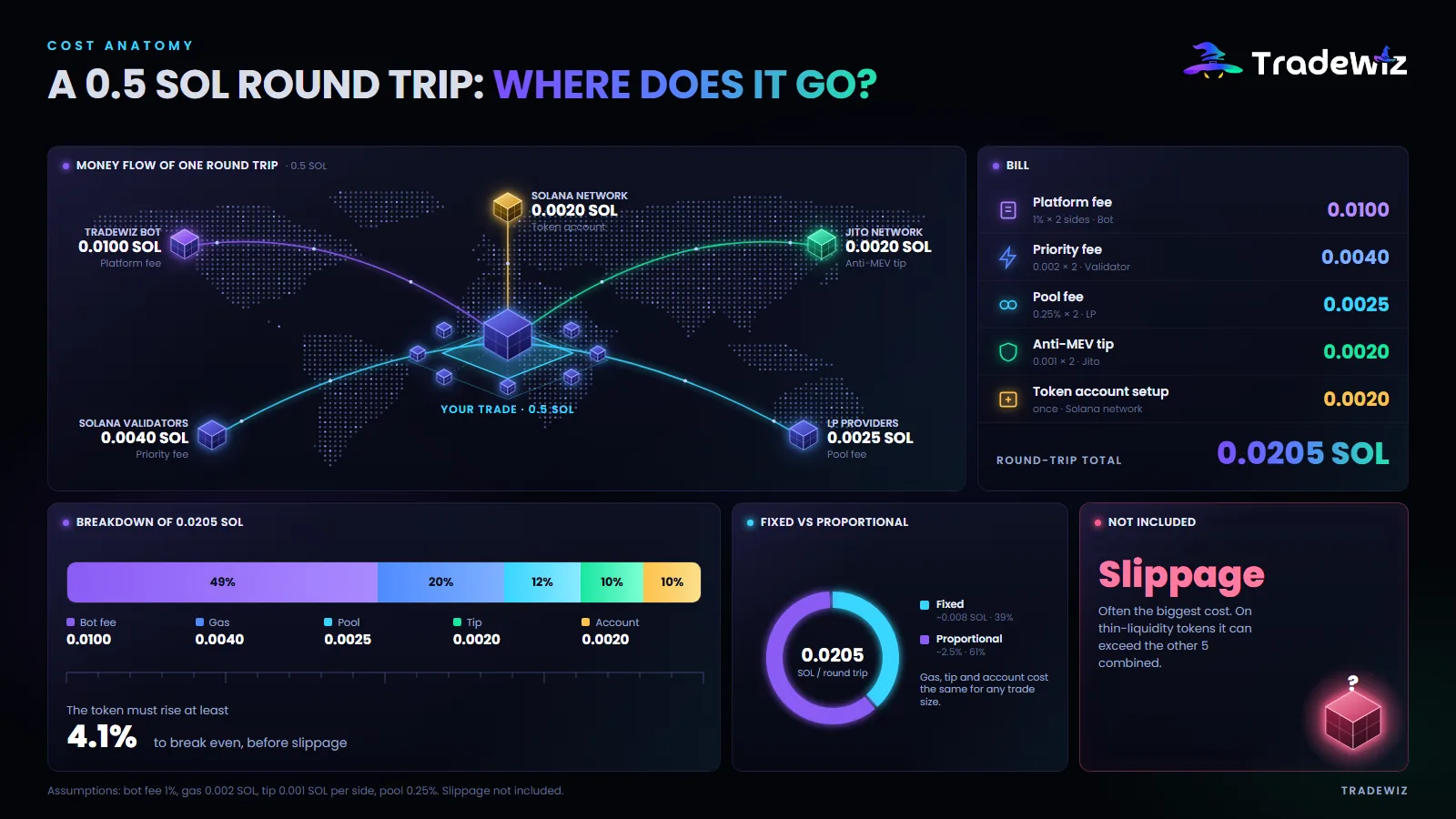
| Cost | How it's calculated | Amount | Who gets it |
|---|---|---|---|
| Platform fee | 1% × 2 sides | 0.0100 SOL | Bot |
| Priority fee | 0.002 × 2 | 0.0040 SOL | Solana validators |
| Anti-MEV tip | 0.001 × 2 | 0.0020 SOL | Jito network |
| Pool fee | 0.25% × 2 | 0.0025 SOL | Liquidity providers |
| Token account creation | Once | 0.0020 SOL | Solana network |
| Total | ≈ 0.0205 SOL, or ≈ 4.1% |
The token has to rise at least 4.1% for you to break even. Before slippage.
Break-even by trade size
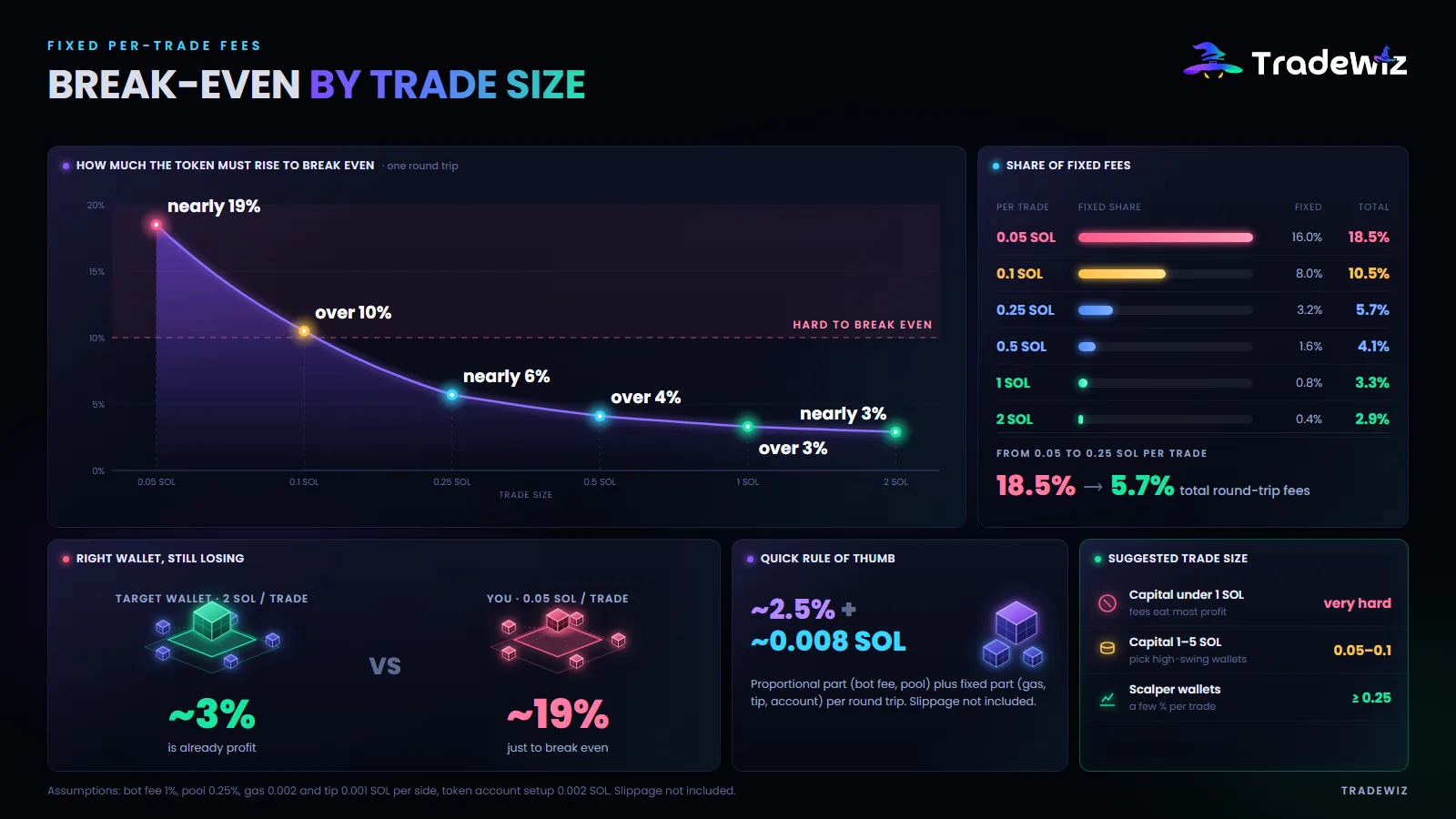
The fixed part (gas, tip, account creation) is about 0.008 SOL per round trip. The percentage part (bot fee, pool fee) is about 2.5%. The smaller the trade, the bigger the share the fixed part takes.
| Per trade | Fixed fees share | Total fees per round trip | Token rise needed to break even |
|---|---|---|---|
| 0.05 SOL | 16.0% | 18.5% | almost 19% |
| 0.1 SOL | 8.0% | 10.5% | over 10% |
| 0.25 SOL | 3.2% | 5.7% | almost 6% |
| 0.5 SOL | 1.6% | 4.1% | over 4% |
| 1 SOL | 0.8% | 3.3% | over 3% |
| 2 SOL | 0.4% | 2.9% | almost 3% |
This table explains why so many people "copy the right wallet and still lose". They trade 0.03–0.05 SOL per trade following a wallet that trades 2 SOL. The target wallet only needs the token to rise 3% to profit. They need it to rise 19%.
The practical conclusion: with less than 1 SOL, it's very hard to make a net profit copy trading memecoins. With 1–5 SOL, each trade should be 0.05–0.1 SOL, and you should pick wallets that go for big moves and hold longer. For wallets that make lots of small trades for a few percent each, you need at least 0.25 SOL per trade.
Why the PnL card doesn't match your balance
The PnL card in the bot is calculated from the token price at buy and at sell. It doesn't subtract gas, tips, account creation fees or the platform fee. So a trade showing 3% profit on the card can be a real loss if the trade is small.
The right way to check: write down your SOL balance before buying and after the sell is done. That difference is your real profit. Always measure in SOL, not USD, because swings in the SOL price will distort it.
6 ways to actually cut fees
- Raise your minimum trade size. This is the biggest lever. Going from 0.05 to 0.25 SOL cuts your fee share from 18.5% to 5.7%.
- Reduce failed trades. Every failed trade without Anti-MEV still costs gas. Sensible slippage and Auto Retry at 1–2 help more than loosening slippage.
- Turn on Anti-MEV. The tip costs 0.001 SOL, but failed trades cost nothing, and you avoid getting sandwiched, which usually costs far more than the tip.
- Pick wallets with fewer trades and bigger moves. A wallet making 10 trades a day for 30% moves costs far less in fees than one making 100 trades a day for 3% moves, even if their gross profit is the same.
- Limit buys per token. Buy Times per Token set to 1 stops you from copying repeat buys of the same token, each with its own set of fees.
- Don't push gas above 0.005 SOL. Past that level you pay more while speed barely changes. Put that money into bigger trades instead.
FAQ
Is a 0.5% fee half as cheap as 1%?
On the platform fee, yes. On total cost, no. On a 0.25 SOL trade, cutting the bot fee from 1% to 0.5% saves 0.0025 SOL per round trip, while entering one block late on a new token can cost you 10%. Speed and filters are worth more than half a percent.
Do failed trades cost money?
Anti-MEV off: you pay gas. Anti-MEV on: no fee.
Can I get the token account creation fee back?
It's rent the Solana network charges for storage tied to the token account. If you copy trade lots of tokens, treat it as an operating cost and include it in your break-even math.
Does joining the referral program lower my fees?
The 1% fee on each trade is still charged as normal. In return, the referral program shares part of that fee as rewards for both the referrer and the referred user, and rewards are sent to your account automatically once they reach 0.05 SOL. If you refer others, it's a meaningful offset to your fees. Details in the Referral guide.
Key takeaway
The 1% figure doesn't tell you what you actually pay. Remember a simple formula: about 2.5% in percentage fees plus about 0.008 SOL fixed per round trip, before slippage. The smaller the trade, the heavier the fixed part. The most effective way to cut fees is to raise your trade size, reduce failed trades and pick wallets that trade selectively.
TradeWiz's full fee schedule is on the Fees page. Gas, tip and slippage settings are explained in the Copy Trading guide.
Trade Fast. Trade Smart.