How to Find Smart Money Wallets Worth Copying on Solana
 2026-09-0810 min read
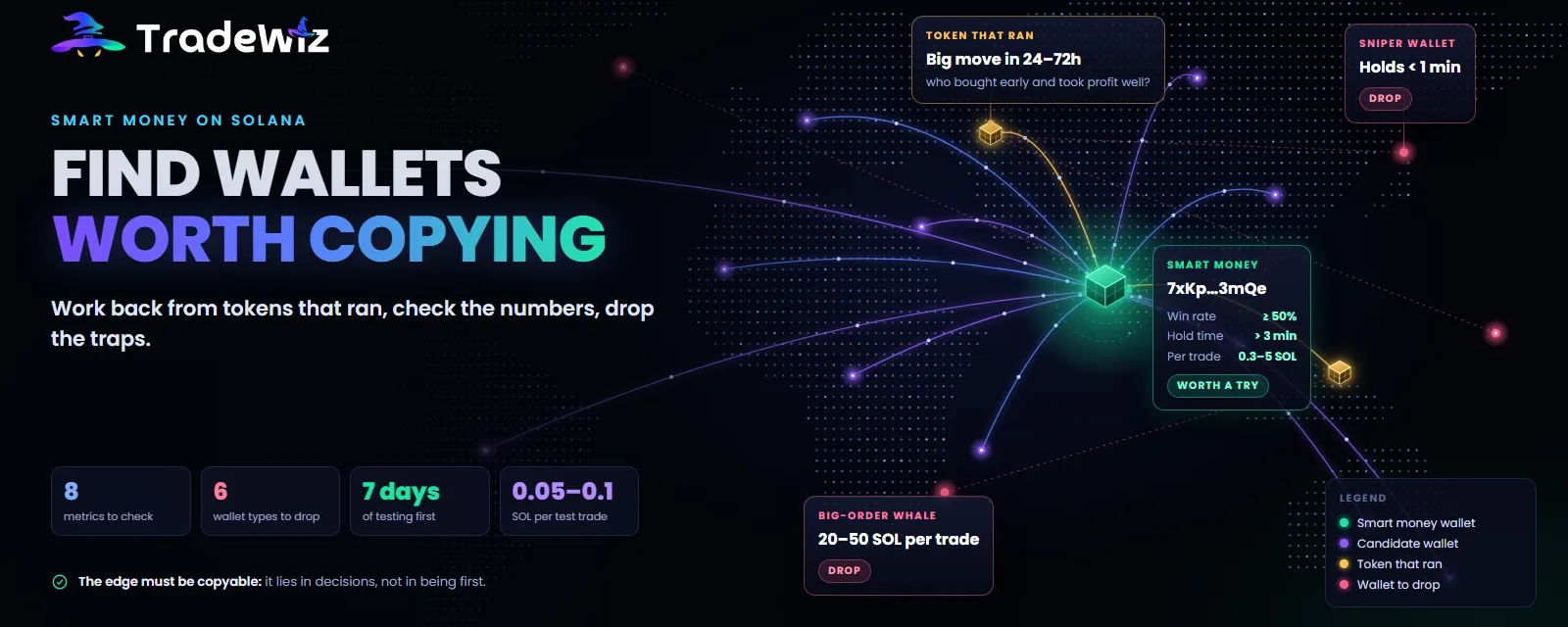
In copy trading, the bot is just the vehicle. The target wallet is the driver. A good wallet with so-so settings still makes money. A bad wallet with perfect settings still loses. Yet most beginners spend 90% of their time tweaking slippage and gas, then pick a wallet from a screenshot on X.
This post lays out a concrete process: where to find wallets, which numbers to check, which wallet types to rule out immediately, and how to test a wallet before you trust it.
Quick summary
- Don't pick wallets by total PnL. Look at realized PnL, win rate, holding time and trade size.
- Six wallet types to rule out immediately: snipers, high-frequency bots, bait wallets, insiders and bundles, inflated PnL, and whales with huge trades.
- A wallet that looks great on a leaderboard doesn't mean you can copy its prices. Its edge has to be something you can replicate.
- Test each wallet with 0.05–0.1 SOL per trade for a week before adding more capital.
What smart money actually is
Smart money means wallets that profit consistently thanks to skill in picking tokens and timing, not thanks to an edge you don't have. That distinction matters a lot for a copy trader.
A sniper wallet that buys in the first block after a token is created can profit very consistently, but its edge is raw speed. Copy it and you always land a few blocks behind, right as it sells. An insider wallet that receives tokens at creation has inside information as its edge. You can't replicate its entry price.
The wallets worth copying are the ones whose edge lies in decisions, not in position. They buy after the token is a few minutes old, hold long enough for you to enter near their price, and sell to a plan instead of dumping in one block.
Where to find wallets
Method 1: Work backwards from tokens that already ran
This is the most effective method. Take a token that pumped hard over the past 24–72 hours, then find out who bought early and took profit well.
In TradeWiz: go to Menu, choose Smart Money and paste the token address. The bot returns a list of the most profitable wallets that bought that token. Tap each wallet to see total PnL, win rate, ROI per token and trade history.
Repeat with 5–10 different tokens. Wallets that show up across several tokens are good candidates, because they didn't just get lucky once.
Method 2: Get daily suggestions
Smart Money has an address suggestion section. Every day you get 3 wallets with high profit and win rate, pre-filtered by the system, for free. You still need to check them yourself against the scorecard below before copying.
Method 3: Featured wallets board
The TradeWiz homepage has a board of high-ROI wallets over a given period. Use it as a starting point, not as your final decision.
Method 4: From the community, but twice as carefully
Wallets shared publicly on X or Telegram have two problems. First, too many people copy them at once, so the price gets pushed the moment the wallet buys. Second, some wallets are set up purely to attract copiers and then dump on them. If you use this source, treat the wallet as unverified.
The 8-metric scorecard
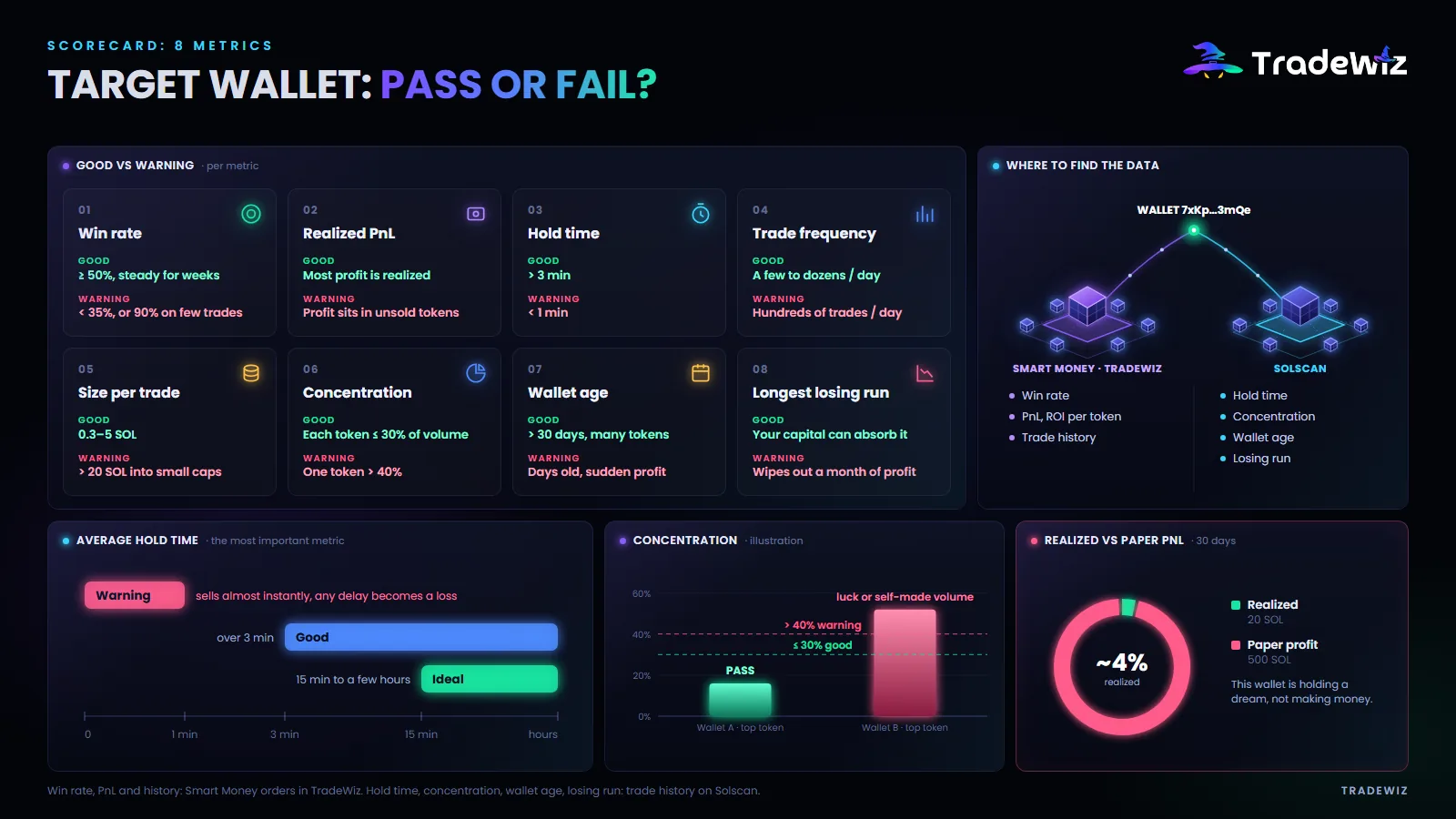
1. Win rate
Good: 50% or higher and stable over several weeks. Warning sign: below 35%, or 90% but over only a few dozen trades. A win rate that looks too good over few trades is usually luck or a freshly built wallet.
Note: a low win rate isn't automatically bad if the wallet wins big and loses small. But for a copy trader, a high win rate is easier to live with psychologically and depends less on one big hit.
2. Realized PnL vs paper PnL
Many leaderboards count unsold profit in total PnL. A wallet holding tokens with 500 SOL of paper profit but only 20 SOL realized over 30 days is holding a dream, not making money. When liquidity dries up, paper profit evaporates.
Prioritize wallets where most of the profit has already been realized in SOL.
3. Average holding time
Good: over 3 minutes, ideally 15 minutes to a few hours. Warning sign: under 1 minute.
This is the most important metric for a copy trader. If a wallet holds for 30 seconds, even if your bot enters in the same block, you have to sell almost immediately, and any delay on the sell turns a profit into a loss.
4. Trade frequency
Good: a few to a few dozen trades a day. Warning sign: hundreds of trades a day.
Every copy trade costs a platform fee, gas, tip and pool fee. If a wallet makes 300 trades a day at 2% profit each, after fees you're almost certain to lose.
5. Size per trade
Good: 0.3–5 SOL. Warning sign: over 20 SOL into small-cap tokens.
The bigger the target wallet's trade relative to pool liquidity, the more the price jumps the moment it buys. You enter right after it, but at a noticeably higher price. This is the most common reason the target wallet profits while you lose, broken down in detail in Why you lose copying a winning wallet.
6. Concentration
Good: no single token accounts for more than 30% of total trading volume. Warning sign: one token above 40%.
High concentration usually has one of two causes. Either the wallet got lucky once and can't repeat it. Or it's trading one token back and forth with itself to fake volume and PnL.
7. Wallet age and history variety
Good: over 30 days of activity, trading many different tokens. Warning sign: a wallet a few days old with a sudden spike in profit.
Bait wallets are usually built fast. A long history is the hardest evidence to fake.
8. Longest losing streak
Look through the history and find the longest run of consecutive losses. Ask yourself: at my trade size, how much SOL would that streak cost? Can I handle it? If one losing streak wipes out a whole month of profit, the wallet doesn't fit your capital, no matter how good its total PnL looks.
6 wallet types that look very profitable but shouldn't be copied
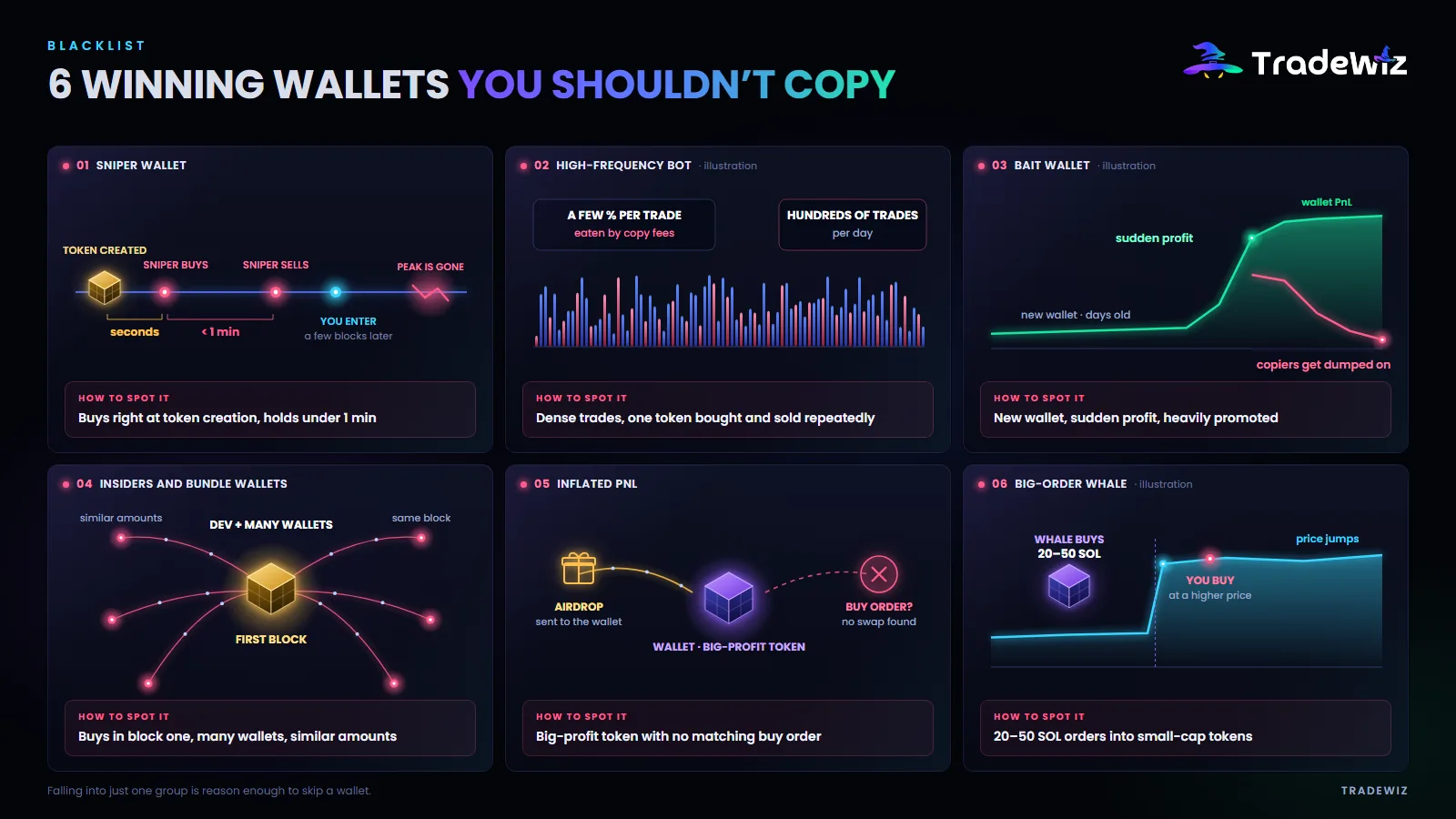
- Sniper wallets. Buy in the first few seconds after a token is created and sell within minutes. How to spot: buy time very close to token creation, holding time under 1 minute.
- High-frequency and arbitrage bots. Hundreds of trades a day, a few percent profit per trade. How to spot: dense trading, the same token bought and sold over and over.
- Bait wallets. Built to have a great track record and attract copiers, then buy their own token and dump on their followers. How to spot: new wallet, sudden profit spike, heavily promoted.
- Insider and bundle wallets. Receive tokens at creation or buy in the same block as the dev across many wallets. How to spot: buys in the very first block, several wallets buying at once with similar amounts.
- Inflated PnL. Profit comes from airdrops or tokens transferred into the wallet, not from market buys. How to spot: tokens with big profit but no matching buy in the history.
- Whales with huge trades. 20–50 SOL per trade into small-cap tokens. How to spot: trades that are large relative to pool liquidity, price jumping hard right after their trade.
A 3-minute cross-check on Solscan
Once a wallet passes the scorecard, open it on Solscan and look at its 10 most recent transactions:
- Buy time vs token creation time. If the buy comes less than 10 seconds after the token was created on many tokens, it's a sniper.
- Is there a real buy? For tokens with big profit, check whether the tokens arrived through a swap or a transfer.
- Who buys in the same block? If every time this wallet buys, 5–10 other wallets buy in the same block with similar amounts, it's a bundle.
- How it sells. Selling in several parts as the price climbs is good. Selling everything in one trade the moment it's in profit is hard to copy.
Test a wallet before you trust it
No wallet gets copied with real capital right away. The testing process:
- Create a separate copy task for that wallet with a clear label.
- Max Buy and Min Buy both at 0.05–0.1 SOL. Sol Spending Limit at 0.5–1 SOL.
- Run it for exactly 7 days or 20–30 trades, whichever comes first.
- Record three things for every trade: how many blocks behind the target wallet you were, how many percent higher your entry was than theirs, and whether the trade was blocked by a filter.
- At the end of the week, work out net profit after all fees.
The wallet passes if: net profit is positive, most trades are no more than 1 block behind, and your average entry is less than 5% above the target wallet's. Only then raise Max Buy.
When to drop a wallet you're copying
- The wallet changes style: trade size spikes, holding time gets shorter, it starts sniping.
- Three weeks in a row of negative net profit even though you enter in the same block.
- The wallet starts getting promoted widely. When thousands of people copy the same wallet, the edge disappears.
- The wallet keeps buying tokens your filters block. That means your risk appetites no longer match.
FAQ
How many wallets should I copy at once?
With less than 10 SOL, 2–3 wallets is enough. More than that gets hard to track and the wallets easily overlap on the same tokens.
A wallet has an 80% win rate and I still lose. Why?
Usually because its trades are too large relative to the pool, so you buy at a higher price, or it sells so fast that your sell lands late. See Why you lose copying a winning wallet.
Should I copy KOL wallets?
Be careful. Many KOLs get tokens for free from projects or are paid to buy. Their profit comes from an edge you don't have.
Key takeaway
Finding smart money wallets isn't about finding the most profitable wallet. It's about finding a wallet whose edge is something you can copy: good decisions, holding long enough, selling to a plan. Use the 8-metric scorecard, rule out the 6 dangerous wallet types, cross-check on Solscan, then test for a week with small size.
The Smart Money tool in TradeWiz makes the finding and checking much faster. Detailed steps are in the Smart Wallet guide.
Trade Fast. Trade Smart.