Solana Sandwich Attacks: $29.7M Taken and How to Avoid Them
 2026-11-2910 min read
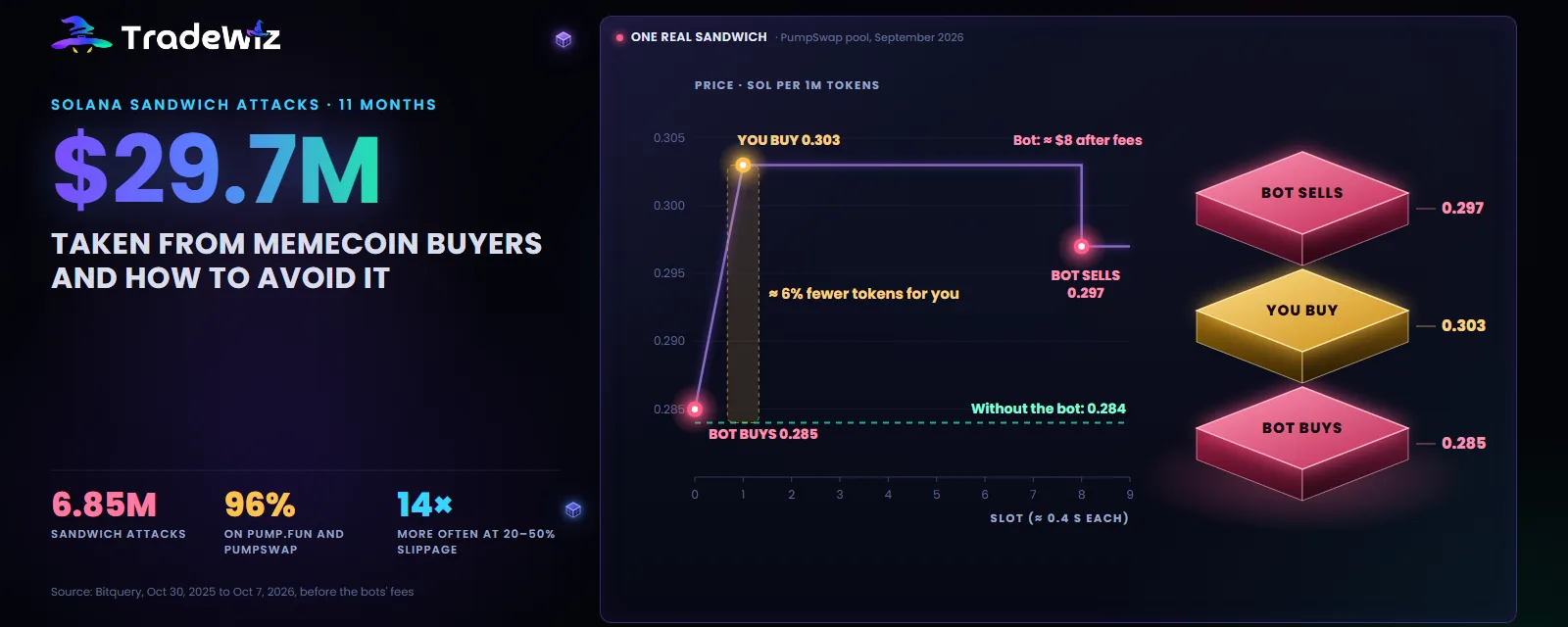
A Solana sandwich attack is a trade wrapped around yours: a bot buys just before you, your buy pushes the price up, and the bot sells to you a moment later. Between October 2025 and October 2026, sandwich bots did this about 6.85 million times and took roughly $29.7 million from Solana traders, almost all of it on Pump.fun memecoins. Those are the findings of a new Bitquery study, and a three-year academic study published in September adds a harder number: users of some popular trading terminals are sandwiched more than ten times as often as their share of trading would predict. Below we explain how a sandwich works using a real attack, what the two studies found, how to check your own trades, and the settings that make you a poor target.
Quick summary
- Sandwich bots took about $29.7M (309,010 SOL, before their costs) in 6.85 million attacks from October 30, 2025 to October 7, 2026. 96% were on Pump.fun's launch curve and PumpSwap.
- Slippage is the room a bot can take. Swaps allowing 20–50% were sandwiched about 14 times as often as swaps under 3%.
- An MEV protection switch helps but is not a shield: the most-hit app's victims had theirs on almost every time.
- Keep slippage as low as still fills, keep each buy small next to the pool, turn on Anti-MEV for buys and sells, and split big buys into thin coins.
What is a sandwich attack on Solana?
Every memecoin pool prices tokens by how much is left in it. Each buy makes the next one more expensive. A sandwich bot uses that: it buys in front of you, lets you pay the higher price, then sells into the price your own buy created.
Here is a real one from Bitquery's study, in a PumpSwap pool in mid-September 2026:
| Step | Who | Trade | Price (SOL per million tokens) |
|---|---|---|---|
| 1 | Bot | Buys 2.77 SOL of the coin | 0.285 |
| 2 | Victim | Buys 2.47 SOL, in the next slot | 0.303 |
| 3 | Bot | Sells everything, 8 slots (about 2 seconds) later | 0.297 |
Without the bot's buy, the victim would have paid 0.284. Instead they got about 6% fewer tokens for the same 2.47 SOL. The bot made about $11 on the round trip and kept about $8 after fees.
What made it possible was the victim's slippage: the maximum price move they told their app to accept. A bot can push the price up to that limit, and not one step further, or your trade fails and the bot is left holding the coin. Wider slippage means more room to take.
Solana has no public waiting room for transactions like Ethereum's mempool, yet sandwiches keep growing. The researchers behind the September study point to validators and the trading apps themselves as the places where orders are exposed. Bots also no longer need to land in the same block as you: in Bitquery's data only 6% bought and sold in the same slot, and in three of four attacks the sell came two to eight slots after the buy.
$29.7M in 11 months: what the Bitquery study found
Bitquery scanned 10.7 billion Solana swaps from October 30, 2025 to October 7, 2026, using the sandwich definition from the academic study below and leaving out sniping in a coin's first slots.
| Finding | Number |
|---|---|
| Sandwich attacks | 6,850,144 |
| Bot wallets doing them | 2,545 |
| Victim wallets | 2,154,994 |
| Taken by the bots, before fees and tips | 309,010 SOL, about $29.7M |
| Median bot profit per sandwich | $2.33 |
| Share on Pump.fun (PumpSwap 62%, launch curve 34%) | 96% |
| Attacks per day, Nov–Dec 2025 vs September 2026 | about 3,400 vs 51,900 |
A few details matter for traders:
- The $29.7M is a floor for what victims lost. In sampled attacks with a single victim, the victim lost 1.2 to 1.3 times what the bot took. The study also skips some exchanges and misses about 1.6% of blocks.
- Bots are victims too. About 39% of the take, roughly $11.6M, came from trades made by other bots: snipers, high-volume wallets and even rival sandwich bots. Automated trading doesn't make you safe if its settings are loose.
- It is a memecoin problem. Bots make the most from large buys in small pools. Deep pools of big coins barely show up.
- It is growing fast. Attacks per day rose about 15 times between late 2025 and September 2026.
Slippage decides how often you are hit
The clearest result is about slippage. Bitquery looked at Jupiter swaps into Pump.fun coins and counted how many in every 10,000 were sandwiched, by the slippage the trader allowed:
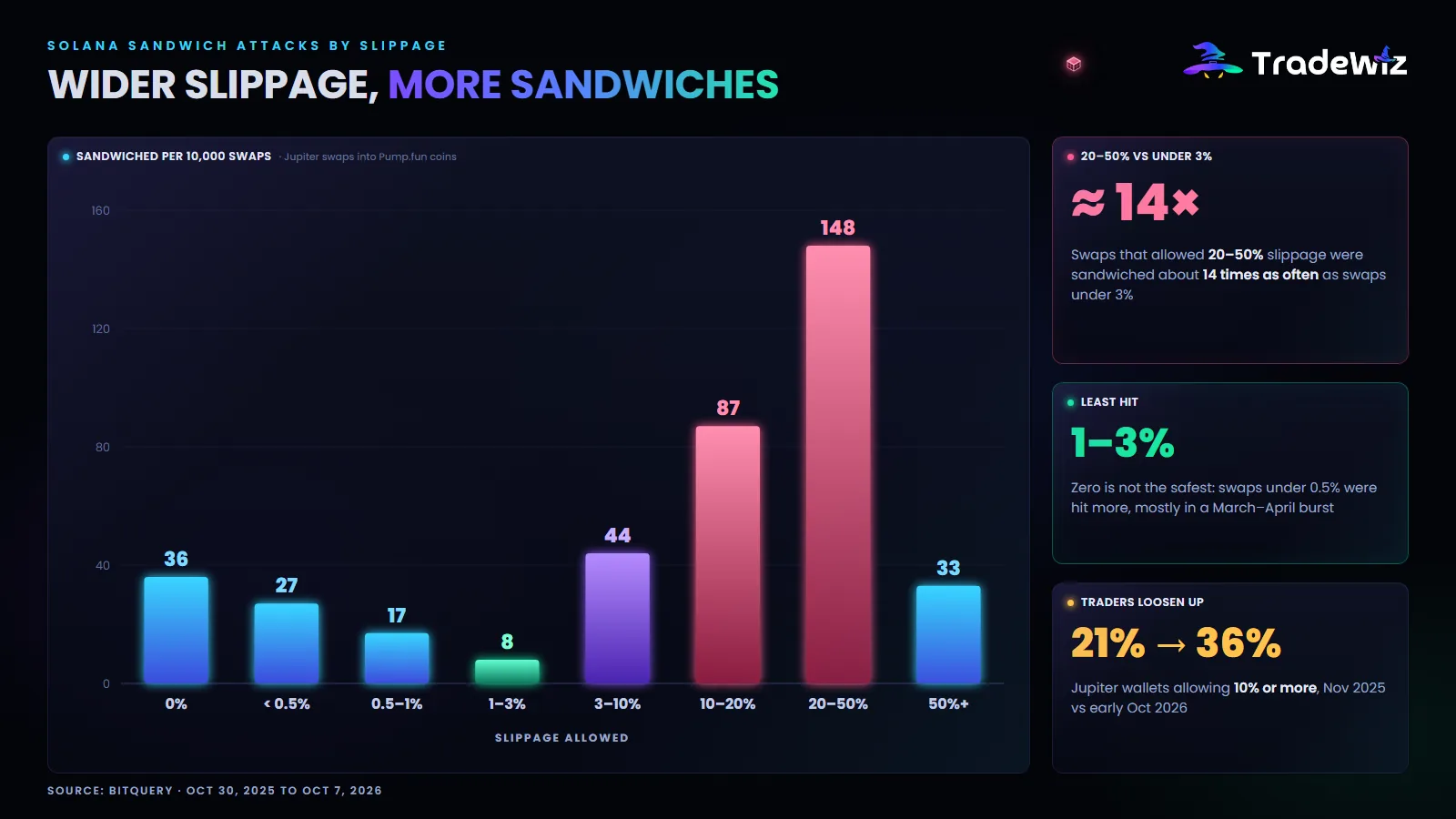
| Slippage allowed | Sandwiched per 10,000 swaps |
|---|---|
| Exact quote (0%) | 36 |
| Under 0.5% | 27 |
| 0.5% to 1% | 17 |
| 1% to 3% | 8 |
| 3% to 10% | 44 |
| 10% to 20% | 87 |
| 20% to 50% | 148 |
| 50% or more | 33 |
Swaps that allowed 20–50% were sandwiched about 14 times as often as swaps under 3%. Two caveats keep this honest. First, part of the gap comes from which coins people trade: wide slippage goes with hotter, thinner coins. Second, the tightest settings were not the safest: swaps under 0.5% were caught more often than those at 1–3%, mostly during a burst in March and April 2026.
Meanwhile traders are loosening, not tightening. The share of Jupiter wallets whose typical swap allowed 10% or more rose from 21% in November 2025 to 36% in early October 2026.
Which apps' users get sandwiched most
The academic study, "No Place to Hide" (arXiv, September 23, 2026, by Lioba Heimbach, Ozan Solmaz, Burak Öz and Christof Ferreira Torres), measured sandwiches against "protected" transactions on six blockchains over three years. On Solana it counted 28.0 million sandwiches by 8,631 bots from July 2023 to June 2026, worth about $383M to the bots before fees.
It also compared trading apps. For each app it divided the app's share of sandwich victims by its share of all Solana swaps (the median over the quarters it was active). A ratio of 1 means an app's users get sandwiched as often as average; above 1 means more often.
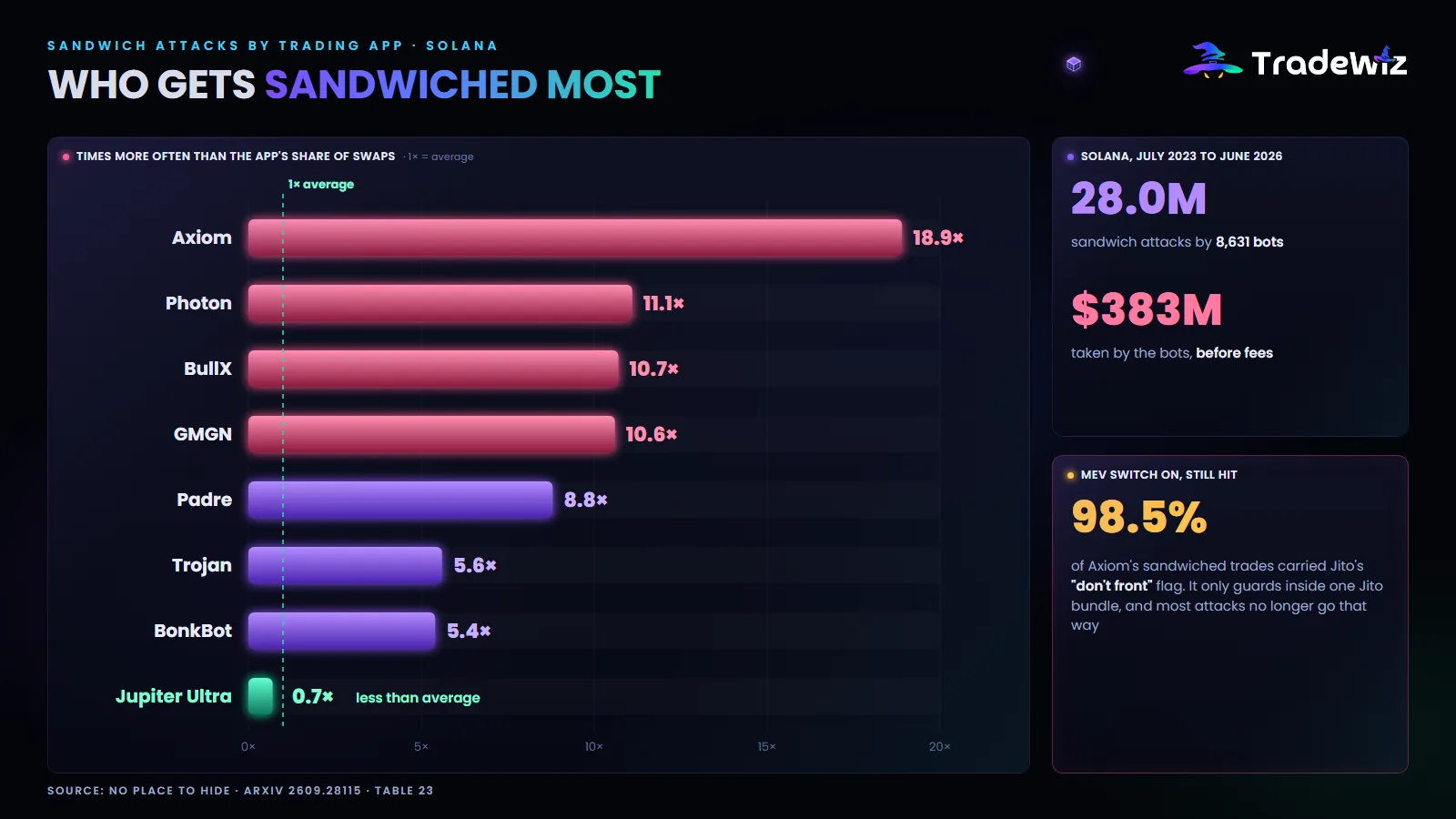
| App | Excess ratio | Single-victim sandwiches only |
|---|---|---|
| Axiom | 18.9 | 8.1 |
| Photon | 11.1 | 7.2 |
| BullX | 10.7 | 5.4 |
| GMGN | 10.6 | 8.5 |
| Padre | 8.8 | 3.3 |
| Trojan | 5.6 | 5.0 |
| BonkBot | 5.4 | 3.9 |
| Jupiter Ultra | 0.7 | 2.0 |
Two findings stand out. Jupiter Ultra was the only app whose users were not over-represented overall. And Axiom set Jito's "don't front" flag on 98.5% of its sandwiched victim transactions, yet its victim share stayed above 37%. That flag only stops another transaction from going ahead of yours inside the same Jito bundle; most attacks no longer go that way. In the paper's words, near-total use of the flag "does not prevent substantial sandwich exposure."
TradeWiz is not one of the apps the paper names, so we have no figure for it. If you are choosing a bot, our Trojan vs GMGN comparison and the copy trading bots page cover fees, speed and security side by side.
How to check if your trade was sandwiched
You can check any trade in a couple of minutes on Solscan:
- Open your transaction and note the time and the token's pool.
- Open the token's trade list (the DeFi Activities tab on Solscan, or the trades panel of any chart site) and find your trade.
- Look a few seconds either side. A sandwich looks like this: one wallet buys the same token just before you, often in the slot right before, and the same wallet sells about the same amount within a few seconds after you. Bitquery's test uses a sell of 99–101% of the bot's buy within about five seconds.
- Compare prices. If the trade right before yours paid noticeably less, and no one else bought in between, the gap is what you paid the bot.
One sandwich costs a few percent. Repeated on every buy, it is a quiet tax on your whole account, the kind of cost our breakdown of copy trading fees warns about.
How to avoid sandwich attacks: the settings that matter
No setting makes you immune. These make you a much smaller target. Settings below are named as in TradeWiz; most bots have the same ones.
1. Slippage: the lowest that still fills
Every percent of slippage is room a bot can take. Bitquery's advice is to keep slippage to a few percent, and its data shows why.
- Graduated coins with deep pools: start with a few percent. The 1–3% band was the least sandwiched in the study.
- Coins on the bonding curve or in their first minutes: prices can jump far within one block, so a tight setting will fail often. Stay within the 15–20% our standard copy trade settings use, and never above 30%, which is the ceiling TradeWiz's own FAQ recommends. If trades fail, use Auto Retry rather than widening slippage, and keep it at one retry: each retry uses the price at that moment.
- PUMP Slippage works differently: it caps the extra SOL you will pay on the Pump.fun curve (150% means up to 2.5 times the SOL). The same logic applies. Keep it near the 25–33% in our standard settings, not at triple digits.
In copy trading there is one more detail. TradeWiz measures copy trade slippage from the copied wallet's price. If the price has already moved 8% since that wallet bought and your slippage is 20%, about 11% is left, and that is what a sandwich bot can take.
2. Keep each buy small next to the pool
Bots make the most from large buys in small pools, because a big buy moves a thin price the most. Use Min LP to skip pools too thin for your size, cap single buys with Max Buy, and if you want a large position in a thin coin, follow Bitquery's advice: split the buy and keep each part's slippage tight. Watch the fixed costs per trade, though. Below about 0.1 SOL, network fees eat a large share of each trade.
3. Turn on Anti-MEV for buys and sells
In TradeWiz, Anti-MEV sends your trade through Jito, which is why a Jito tip is charged when it is on. Two practical upsides: failed trades with Anti-MEV on are not charged, and the Auto Trade guide suggests it for any trade over $100. Turn it on for both buys and sells, in every module that has it: copy trades, the sniper, Auto Trade and manual trading.
Just don't treat it as the whole answer. As the Axiom numbers show, a protection switch reduces one route, not every route. Slippage and size still decide how much a bot can take.
4. Pay a sensible priority fee and tip
A priority fee doesn't block a sandwich bot. What it does is land your trade sooner, so the price has less time to run and a tighter slippage still fills. TradeWiz's FAQ notes that above 0.005 SOL the speed gain is barely visible; our standard settings use 0.002–0.003 SOL with a 0.001–0.002 SOL tip. The post on where copy trade speed is lost shows where the rest of the delay comes from.
Settings at a glance
| Setting | Where in TradeWiz | Suggested |
|---|---|---|
| Slippage, deep pools | Copy trade task, Settings, Sniper | A few percent |
| Slippage, bonding curve | Same | 15–20%, never above 30% |
| PUMP Slippage | Copy trade task | About 25–33% on buys |
| Auto Retry | Copy trade task | 1 |
| Anti-MEV | Buy and Sell, in each module | On |
| Priority fee / tip | Gas fee, Buy/Sell Tip | 0.002–0.003 SOL / 0.001–0.002 SOL |
| Min LP, Max Buy | Copy trade task | Pool many times your buy size |
These are our suggestions, not figures from the studies. Sniping brand-new tokens is the hardest case; our guide to sniping Pump.fun tokens covers those settings.
FAQ
What is a sandwich attack in crypto?
A bot places a buy just before yours and a sell just after it in the same pool. Your buy lifts the price, so you pay more, and the bot sells at that higher price. The bot's profit is what you overpaid.
How much do Solana sandwich attacks cost traders?
Bitquery counted about $29.7M taken by bots in 6.85 million attacks between October 2025 and October 2026, before the bots' own costs. Victims lose more than that, about 1.2 to 1.3 times the bot's take in sampled cases. The median bot made $2.33 per attack.
Does low slippage stop sandwich attacks?
It cuts them a lot, but zero is not the safest. In Bitquery's data, 1–3% was hit least, while swaps under 0.5% were hit more often, mostly during a burst in March and April 2026. Use the lowest slippage that still fills for that coin.
Does MEV protection stop sandwich attacks on Solana?
Not fully. The September 2026 study found the most-hit app set Jito's protection flag on almost every sandwiched trade. Turn it on, but keep slippage and trade size under control as well.
Are copy trading bots sandwiched too?
Yes. About 39% of what sandwich bots took came from other bots' trades. A copy bot with 30–50% slippage on thin Pump.fun coins is exactly the kind of order sandwich bots look for.
Key takeaway
Sandwich attacks on Solana are not rare bad luck. They happen tens of thousands of times a day, mostly on Pump.fun coins, and they target loose slippage. Keep slippage as low as still fills, keep each buy small next to the pool, turn on Anti-MEV, and check a few of your own trades on Solscan. A few percent saved per trade is a lot over a month of copying.
Compare 20+ bots on security, fees and copy trading on our copy trading bots page. To set this up today, TradeWiz on Telegram has every setting above, explained in the Copy Trading guide.
Trade Fast. Trade Smart.
Some links are referral links: you pay no extra fees, and we may earn part of the trading fees. Sources: Bitquery, "Solana sandwich bots took $29.7M from memecoin buyers" (figures checked October 11, 2026); Heimbach, Solmaz, Öz and Ferreira Torres, "No Place to Hide", arXiv 2609.28115 (September 2026); TradeWiz guides. Checked on November 29, 2026. Nothing here is financial advice; memecoin trading is high risk, only trade money you can afford to lose.