Why You Lose Copying a Winning Wallet: 7 Causes and Fixes
 2026-09-159 min read
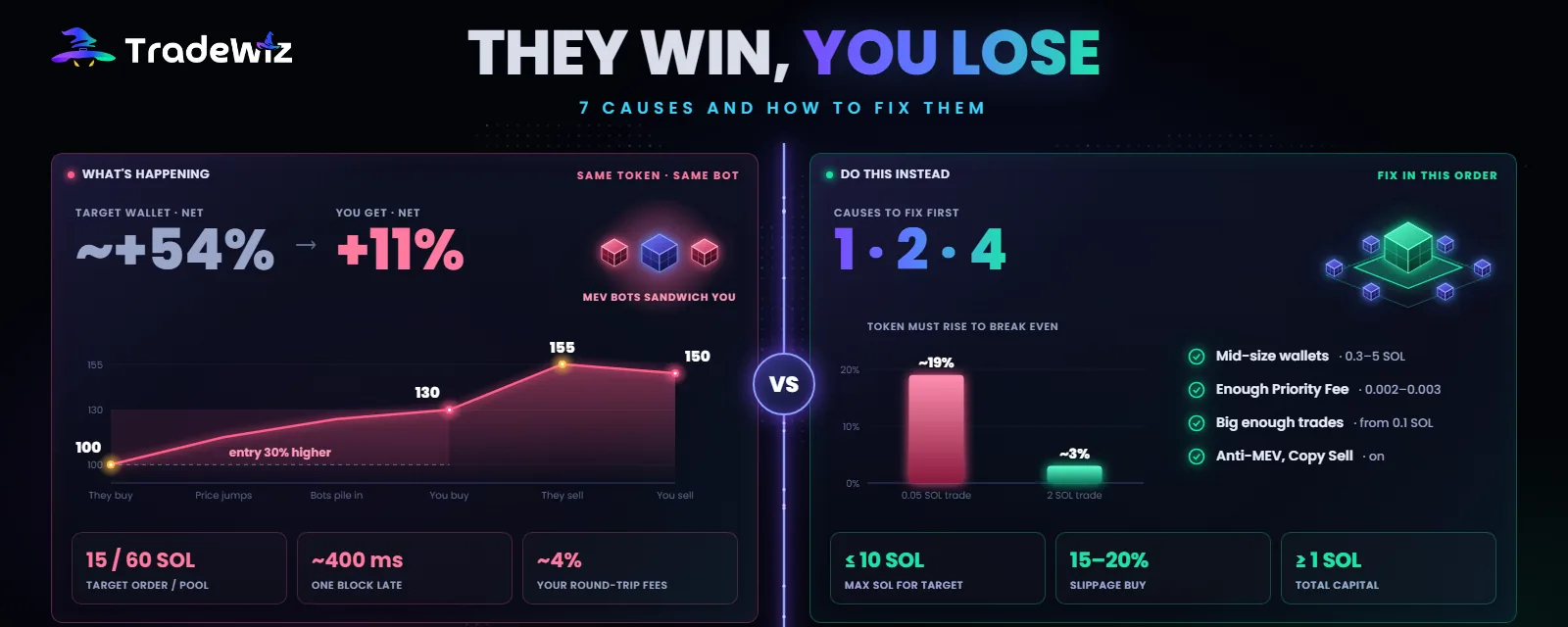
It's the most asked question in every copy trading group: "The wallet I copy shows 50% profit on this token, so why is my trade in the red?" There's no mystery here. Copy trading doesn't copy profit, it copies actions. Your profit depends on three things the target wallet doesn't control: the price you get in at, the price you get out at, and the fees you pay.
This post goes through each source of the gap, explains why it appears and which setting fixes it.
Quick summary
- The entry price gap usually comes from the target wallet's own trade: a big order into a thin pool pushes the price up before you can buy.
- A 1–2 block delay, wide slippage and fixed fees together can turn their 30% winner into your break-even trade.
- The three most common causes are an oversized original trade, a late entry, and a trade of yours that's too small. Fix those three first.
- If the target wallet's edge comes from position (sniper, insider) rather than decisions, no setting can save you. Switch wallets.
An example in numbers
Let's follow one trade from start to finish.
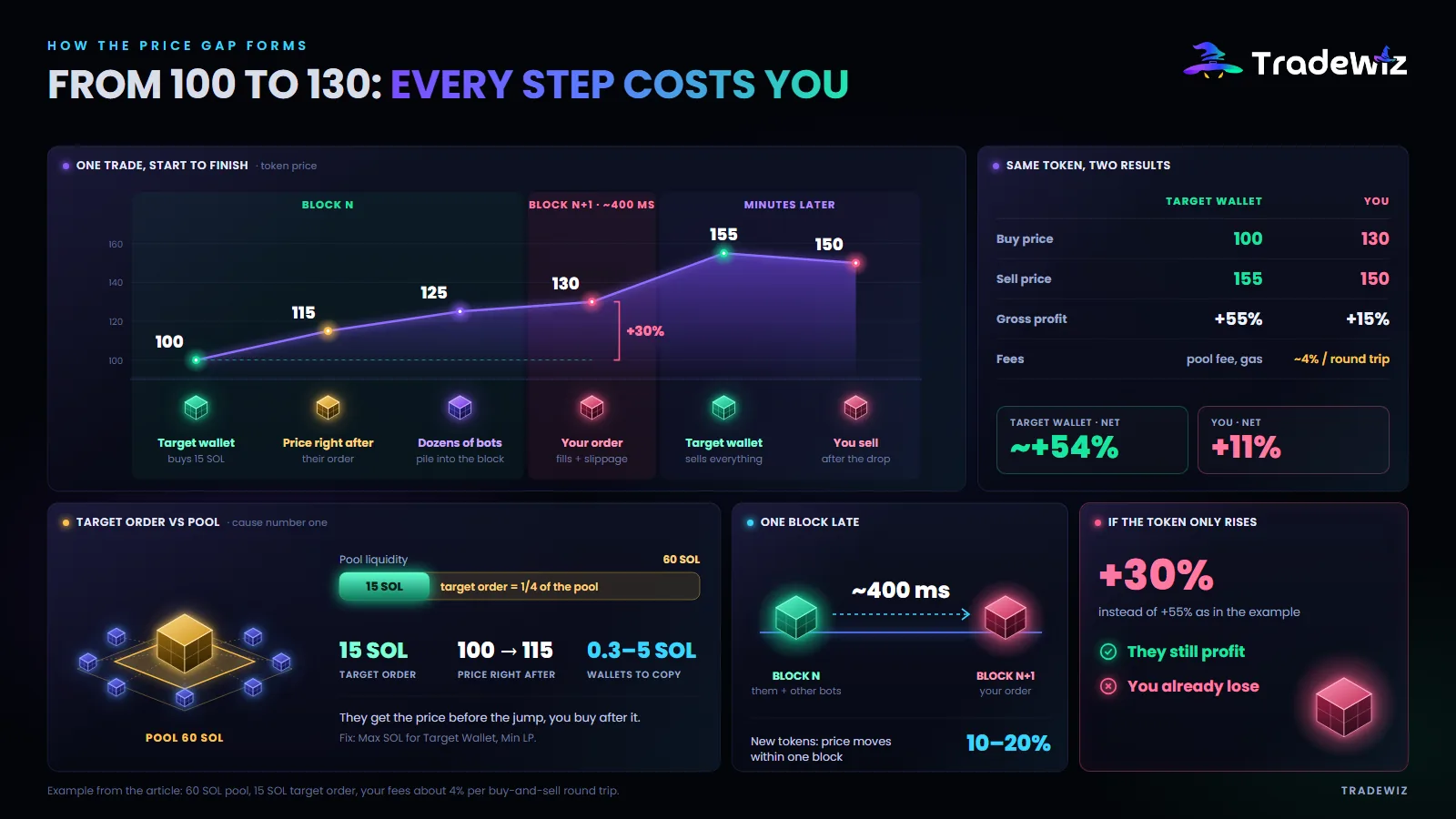
The target wallet buys 15 SOL of a token with a 60 SOL pool. That order alone pushes the price up noticeably: they get an average price of 100, but the price right after their trade is already around 115. In the same block, dozens of other bots copying this wallet pile in and the price hits 125. Your trade lands in the next block and fills at 130 because of the extra slippage you allowed.
A few minutes later, the target wallet sells everything at 155. The price drops right after their sell. You sell along with them at 150.
| Buy price | Sell price | Gross profit | Fees | Net profit | |
|---|---|---|---|---|---|
| Target wallet | 100 | 155 | +55% | Their pool fee and gas | about +54% |
| You | 130 | 150 | +15% | about 4% per round trip | +11% |
Same token, same day, one side makes 54%, the other makes 11%. And if the token had only risen 30% instead of 55%, the target wallet would still be in profit while you'd already be at a loss. Nobody cheated you. That's just market mechanics.
7 causes and how to fix them
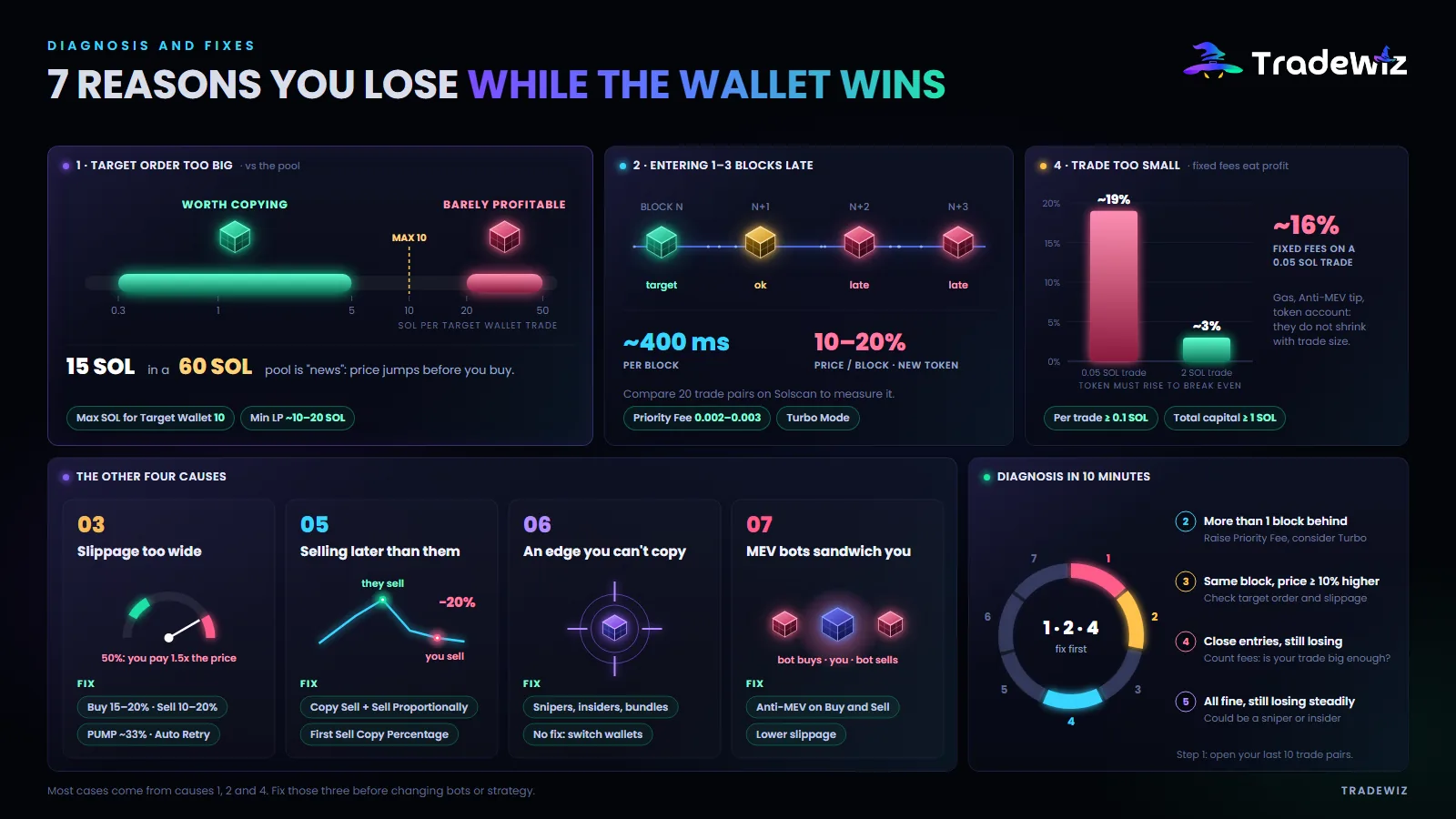
1. The target wallet's trade is too big for the pool
This is the number one cause and the most overlooked. On a thin-liquidity pool, a 15 SOL order is "news" in itself that makes the price jump. The target wallet gets the price before the jump, you buy after it. The bigger they trade, the wider the gap.
How to fix it:
- Favor wallets with trade sizes of 0.3–5 SOL. Wallets putting 20–50 SOL into small-cap tokens are almost impossible to copy profitably.
- Use Max SOL for Target Wallet to skip oversized original trades. For example, set it to 10 SOL: when the target wallet trades more than 10 SOL, the bot doesn't copy.
- Use Min LP to only copy tokens with deep enough pools, for example the equivalent of 10–20 SOL or more for small capital.
2. You enter 1–3 blocks late
Each block on Solana is about 400 milliseconds. On a new token, one block can mean a 10–20% price difference. You land late because your gas is below the going rate, because the network is congested, or because the bot detects the target wallet's transaction a beat late.
How to fix it:
- Priority Fee of 0.002–0.003 SOL for both buys and sells. Above 0.005 SOL, the extra benefit isn't noticeable.
- If you care more about speed than filters, turn on Turbo Mode. It skips some checks to process faster, and in exchange you lose the market cap, liquidity and renounce filters, the SOL limit based on the original trade, and the proportional selling option.
- Measure it yourself: open your 20 most recent trade pairs on Solscan and compare your block with the target wallet's. If you're consistently 2–3 blocks behind, the problem is your gas or the bot.
3. Slippage is too wide
Many people loosen slippage to 50% "to make sure it fills". Two consequences: you accept paying up to one and a half times the price at the moment you sent the trade, and MEV bots see that gap and sandwich you.
Pump.fun tokens work differently: the number of tokens you receive is fixed, and the SOL you pay rises with the price. A PUMP Slippage of 50% means you might pay 50% more SOL than expected. That's why some trades go over Max Buy.
How to fix it:
- Buy slippage 15–20%, sell 10–20%. PUMP Slippage around 33%.
- When trades keep failing on slippage, turn on Auto Retry at 1–2 instead of loosening slippage.
- Turn on Anti-MEV in both directions.
4. Your trade is too small and fixed fees eat the profit
Gas, Anti-MEV tip and the token account creation fee stay the same whether you buy 0.02 or 0.5 SOL. On a 0.05 SOL trade, those fixed costs are about 16% of the trade value. Add the percentage fees and the token has to rise almost 19% for you to break even. A target wallet trading 2 SOL only needs a 3% rise to profit.
How to fix it:
- At least 0.05 SOL per trade, ideally 0.1 SOL or more. At least 1 SOL in total capital.
- For wallets making lots of small trades for a few percent each, you need at least 0.25 SOL per trade to have a chance at net profit. If your capital isn't there yet, pick wallets that hold longer and go for bigger moves.
- See each fee broken down in Solana copy trading fees.
5. You sell later than they do
The target wallet sells 100% in one trade. The price drops 20% right after. Your sell lands a beat later, at the already-lower price. The gap on the sell is often even bigger than on the buy, because panic selling drops the price faster than buying pushes it up.
How to fix it:
- Turn on Copy Sell and Sell Proportionally to Target Wallet to sell the same proportion they do.
- Turn on First Sell Copy Percentage: the first time the target wallet sells any amount, you sell a fixed percentage of what you hold, for example 50%. You get part of the way out early instead of waiting for them to dump everything.
- Set your own exit plan with Copy Trade Auto Sell or a Trailing Stop. Once the price has done 2–3x, you don't need to wait for them.
6. Their edge can't be copied
If the target wallet is a sniper buying in the first block, an insider receiving tokens at creation, or a bundle wallet buying alongside the dev, their entry price comes from position, not from decisions. You'll never have that position. Every copy trade you make becomes their exit liquidity.
How to fix it: there's no settings fix. Switch wallets. Pick wallets that buy after the token is a few minutes old, hold for more than 3 minutes and sell in several parts. How to find smart money wallets worth copying has a scorecard and a list of 6 wallet types to avoid.
7. MEV bots are sandwiching you
An MEV bot sees your pending buy with wide slippage. It buys ahead of you, lets your trade push the price up, then sells right after you in the same block. You buy at a small top you created yourself.
How to fix it:
- Turn on Anti-MEV for both Buy and Sell. Your trades go through a private channel, so sandwich bots can't see them coming. Failed trades with Anti-MEV on aren't charged a fee.
- Lower your slippage. The wider the slippage, the more room a sandwich bot has.
- If trades keep showing a generic error with Anti-MEV on, turn it off temporarily to see the real reason, usually slippage or insufficient balance, then turn it back on.
A 10-minute diagnosis
When you find yourself losing while the target wallet wins, work through this in order:
- Open your 10 most recent trade pairs. Record how many blocks behind you were and how many percent higher your entry was than theirs.
- If you're consistently more than 1 block behind: raise your Priority Fee and consider Turbo Mode.
- If you're in the same block but still paying 10% or more above them: the problem is the original trade size or your slippage. Check how many SOL the original trade was relative to the pool.
- If your entries are close but you still lose: do the fee math. Is your trade big enough?
- If everything checks out and you still keep losing: look at how they sell and when they buy relative to token creation. They may be a sniper or an insider.
Most cases stop at step 2, 3 or 4.
When it's not your fault
Some trades can't be copied even with the right settings:
- The token just completed its bonding curve on Pump.fun and is migrating to its main pool. For those few seconds, there's no pool to trade on.
- The Solana network is heavily congested and transactions don't get pushed through in time.
- The target wallet bought on a pool the bot doesn't support.
These cases are rare and not systematic. If you see them happening over and over, send the transaction hash to the official support group to have it checked.
Key takeaway
When the target wallet wins and you lose, it's not because the bot is broken or because you're unlucky. It's the sum of many small gaps: a higher entry because of a big original trade, one block of delay, wide slippage, fixed fees on small trades, a late sell, and sometimes a wallet with an edge you can never have.
Fix it from the top down: pick wallets with moderate trade sizes, set enough gas, tighten slippage, raise your minimum trade size, turn on proportional Copy Sell, and drop wallets whose edge is position. Every setting mentioned in this post is in the Copy Trading guide for TradeWiz.
Trade Fast. Trade Smart.